Showing posts with label mountains. Show all posts

Monday, October 10, 2005


There was another vacation site in the mountains east of L.A. that everyone seemed to visit at some point. It was called Arrowhead, and in those mountains was a retreat center called Mountain Home. After Lockhaven Christian School, I transferred to Airport Junior High, an extremely traumatic transition. I made a Christian friend through the choir named Eunice Mullisen. (That’s Eu-neece, not Eu-niss.) What a character – she reminded me even in eighth grade of an old lady. I decided she had spent too much time with her (relatively) elderly mother and not enough time with her peers. She was un-hip in the extreme.

Eunice was the first person I had ever spent time around who constantly called me by name. For some reason, our family had a habit of very rarely speaking anyone’s name. We would just speak directly to them, perhaps getting their attention with a preliminary sentence. But Eunice started many, many sentences with, “Gwen, did you know…” or “Gwen, I think…” or whatever. It irritated me! And I couldn’t have told you why. Later on, I decided that it felt a combination of manipulation (ingratiating, like she wanted something from me, like a salesman using my name as a false-intimacy technique) and offense (“Does she think I’m stupid that I don’t know she’s talking to me?”) Clearly, I’ve thought way too much about this minor irritation, and my reaction to it is disproportionately strong. But there you are.

Eunice invited me to come with her church youth group to Mountain Home for a week’s camping experience, and my parents allowed it. I was a very religious young person. At that age I was loyal to my status as a member of the Churches of Christ. While I was growing up, the leaders in that movement spent a great deal of energy emphasizing the distinctives that made us different from all the other denominations (including our claim that we were not a denomination, but the closest thing to the True Church, church like it was in the New Testament).

I don’t recall hearing very much about prayer, faith, salvation, sanctification, the power of the Holy Spirit, the development of personal character. Instead, we heard a lot about believers’ baptism by immersion vs. all the less acceptable forms of baptism used by the denominations. We were taught a cappella singing (the kosher “New Testament” way) vs. instrumental music (dangerously carnal, not to mention unscriptural). We believed in congregational autonomy vs. boards of governance, conferences, presbyteries, bishops, etc.; we had ministers or preachers vs. pastors, priests, etc.; and so on. I felt the need to bone up on Baptist doctrine before going to camp. I wanted to be prepared to argue and debate, should any issues come up where “we” disagreed with “them.” Thankfully, I never felt the need for debate arise.

This retreat center, Forest Home, was supposedly the place where the famous hymn “How Great Thou Art” was composed. The lyrics were carved on a huge piece of wood and displayed in the meeting hall at the center. The hymn was supposed to have some relation to Billy Graham, like it was his favorite song, or he got saved in a meeting where it was sung…something like that. Anyhow, all I knew was that I didn’t like it all that much. Was it because I knew it belonged to “them”? I loved “A Mighty Fortress is Our God” and I knew it was Lutheran. Who knows.

At camp one morning we were all encouraged to spend an hour alone. We were given a little pamphlet to read during that hour. It described how our hearts had rooms in them, and though we may have invited Jesus into some of the rooms, we might be keeping him out of others. I believe this was my first time to meditate on the concept of Jesus “living in my heart.” When I was a child, this was not exactly a Church of Christ idea. I think we didn’t talk much about the heart. Folks in the Churches of Christ at that time talked a whole lot more about “the Church” than we did about Jesus, or even God. That was about to change for me, but I didn’t know it yet.

Only three years later, how different things can be! This time, I was back at Forest Home with an altered point of view. My dad had died, and in the wake of his death my mom didn’t have much energy to worry about where I went or who I was with. I was allowed to rehearse and perform with a choir of my friends from high school. Under the direction of our high school choir conductor, Mr. Fontana, we premiered a terrific new piece of choral church music at Forest Home for a conference of choral conductors.

We rehearsed a few weeks for that event in the church where David Morales’ Firebranders rehearsed. Janice Hahn’s cousin Jackie Stalcup was dating Dave, so she was in the group. I especially remember Evelyn Ono and her friend Marcia Okawa. Evelyn actually had the chutzpah to walk out of rehearsal one day, because she was so angry at something – whether it was the horsing around and wasting time, or the choir’s lack of reverence for the music’s message, I’m not sure. I had never witnessed someone my age taking such a strong public stand.

It was the summer of 1969. After rehearsal one night, we walked over to the Hahns’ house near the church. We watched on TV while a man took his first step on the moon. It was so amazing to walk outside the house onto the lawn, look up at the moon, and try to comprehend that at that very moment a man was walking around up there. I missed my dad, who I knew would love to have witnessed that event. He was so excited a few years earlier to have me watch John Glenn broadcasting on live TV as he was orbiting the earth. I complained that the picture was too bad to know what I was seeing. I was unimpressed, and commented that Mr. Glenn looked like a monkey. I knew I disappointed my dad that I was so disinterested.


We didn’t take vacations when I was little because there wasn’t much money. But as Pepperdine prospered, we did better, and Momma and Daddy loved to travel, so we started a summer routine that lasted a few years. We drove up the coast past Santa Barbara and another hour or two to a quiet town called Paso Robles. Chip was with us on at least one of these trips, but after that it was just the three of us. There was a Spanish-style hacienda where we spent the night and had a nice supper. Not far from there, on the ocean, was San Simeon where William Randolph Hearst built his “castle”.

Hearst Castle was really an enclave, a compound where several different smaller mansions surrounded the giant one. Since I had already been to Europe and seen real castles, this one seemed a more accessible, American version. Mr. Hearst called the estate his “camp”, and he liked to keep it somewhat casual, with ketchup and mustard bottles sitting on the enormously long refectory table. He filled the mansions with paintings, sculptures, and architectural pieces from all over Europe, including ceilings, fireplaces and gargoyles. Someone commented that if such great American collectors as he had not bought up many of Europe’s treasures, they would have been lost to the public or destroyed in the World Wars. I love a quote from George Bernard Shaw, who was a guest of Mr. Hearst’s, “This is the way God would have done it – if He had the money.”

The next day, we drove on up to Carmel and Monterey. There was a hotel there, the Highlands Inn, that was my ideal for many years. I imagined having my honeymoon there. The cliffs above the ocean at Carmel are a bit like Scotland and Ireland, and the hotel was built in such a way as to provide the best of both worlds – the grand hotel’s luxury, and the cozy comfort of little bungalows. All along a hillside were paths leading to private cottages, and that’s where we stayed. The cottages had a bedroom and a sitting room with a working fireplace, so on misty cool nights you could have a fire in the fireplace. The internet reveals that there are no more little cottages, but the main hotel still sounds like a great place to stay.

Daddy was such a romantic about fireplaces. At the Gray House, where we were living by now, many nights we would turn up the air conditioner and have a fire in the fireplace in summer. When we were in the mountains at the cabin, we always had a fire, and it was one of my favorite things to set it up properly so it would burn well, and then poke at it and play with it to keep it hot. I actually became a bit of a pyromaniac, and played with fire so that a lump of burning plastic wrap once popped onto my hand. The burn left a “spoon-shaped scar,” as I described it in my little red Travel Abroad trip diary at the age of ten. (Daddy thought that description was clever and was amazed that I came up with it myself.)

In Carmel, we would stay in the cottage, but we would return to the hotel and eat our meals in their luxurious dining room. It overlooked the ocean, and the service was elegant, like the waiters in Europe, solicitous and dignified, which added to the pleasure of the food. There were shops in Carmel and Monterey that were fun to walk around, but mostly we did nothing while we were there but read in the cottage and walk. It was a nearly silent vacation, which both working parents needed, but it made me yearn for a relationship of my own.


Our church at Vermont Avenue was generally quiet. We didn’t go for rowdy melodies in our songs, and we didn’t usually have emotionally moving sermons. Everything was calm, and reverent, and reserved. So it was really unusual when a black preacher, Marshall Keeble, came to Pepperdine and lots of people gathered to hear him preach. There were so many people that we met in the Pepperdine Auditorium (which I knew well because of The King and I and the other musicals). I couldn’t have explained to you at that time what the difference was, but Bro. Keeble’s was the first emotionally stirring sermon I had ever heard.

At the end, he asked anyone who wanted God’s help to “come forward”. “Going forward” meant you stood up and walked to the front of the auditorium. Then you sat in the front pew and told the minister quietly what was on your heart. I was familiar with the practice of coming forward when a family had moved to town and wanted to “place membership” in a congregation. I was familiar with coming forward if somebody felt really, really guilty about something and wanted to “ask for the prayers of the church.”

I’m putting all these phrases in quotes because they were the standard phrases that members of the Churches of Christ would use for these things. I had never really heard what is commonly called an “altar call.” The Churches of Christ that I had attended or visited tried to downplay emotion. They always quoted the New Testament verse that everything should be done “decently and in order.” Emotional appeals and emotional responses were discouraged.

Just a moment’s “time out” to note one of the odd things about my religious upbringing. The Churches of Christ were firmly opposed to creeds, liturgy and repetitive formulations, teaching that those were things the “denominations” did and that God was not pleased with them. This could have been a response to Jesus’ statement that God’s children should not be like the Pharisees, thinking they would get God’s attention with their “vain repetitions.” (Matthew 6:7) At any rate, human nature and self-consciousness about public speaking led many men to unconsciously memorize phrases they had heard others use when they got up to pray, preside over communion, take an offering, etc. So we ended up doing the very thing we taught against. Since we traveled and visited other churches, I discovered that you could be in different congregations in different states and still here some of the same language used over and over.

One of my Nashville friends in later years cracked us up as he recalled the many pat phrases from his youth. “Heavenly Father, God of our Lord Jesus Christ, we come humbly before Thee this morning, asking that Thou wilt accept our prayers. We pray that Thou wilt bring to a ready recollection those things which our preacher has studied from Thy holy Word. May our worship be found pleasing in Thy sight. Guide, guard and direct us, and, if we have been found faithful, and in the end save us and grant us a home with Thee, is our prayer. In the name of Thy beloved Son and our Savior, Jesus Christ, Amen.”

Back to the Sunday when Marshall Keeble spoke, I was only nine years old. I had been raised in a family where my faults were pointed out on a daily basis. I wanted some relief from the guilt and hopelessness. I knew God was my only source of forgiveness. (Remember, my parents had told me when I was about five that they couldn’t help me in that department.) I knew I was a mess. My folks agreed that we would have a happy family if not for me. I was the problem. So I was desperate for God’s help. Bro. Keeble’s message offered hope, and of course I went forward!

When hundreds of people (all the rest of them being adults) made their way down front, someone decided that we should get a chance to speak about why we came, what we wanted from God, etc. So they asked all those who responded to move to the top floor of the Administration Building, where there was a smaller theater. There we could talk with Bro. Keeble. Even though I was the only child in the group, my heart was yearning after more of this experience, and I went with them. And I even had the passion or nerve or desperation to stand up in the midst of them and declare, “I need God’s help because I am a bad child and I want to be a better one. I want to be more obedient to my parents.”

That night, we were driving downtown to the Shrine Auditorium. I was in my usual place in the back seat of the car, and I decided to risk opening my heart to my folks and telling them what had happened to me that morning. I did, and their response is foggy to me. I know it was disappointing. They basically agreed that I needed to change. I didn’t sense that they were touched by what I had done.


0 ~ o ~ 0 ~ o ~ 0

When we were growing up, my family, the Youngs, and just about everybody else at Pepperdine were members of this movement, the Churches of Christ. When we kids were sent to Lockhaven Christian School, our parents had to explain about the existence of other churches and denominations. That school was operated by the Christian Church, an offshoot of a larger group called Disciples of Christ. We were the Southern offshoot of that movement, a division that occurred around the Civil War era, but we kids didn’t learn this at that age. There were also children in the school who were Baptists and Lutherans and various other flavors. Our parents didn’t teach us that we were the only Christians, but we were taught a lot about how our group was different from all the other groups. We didn’t think we were perfect, but we did suspect that we were more right than anybody else.
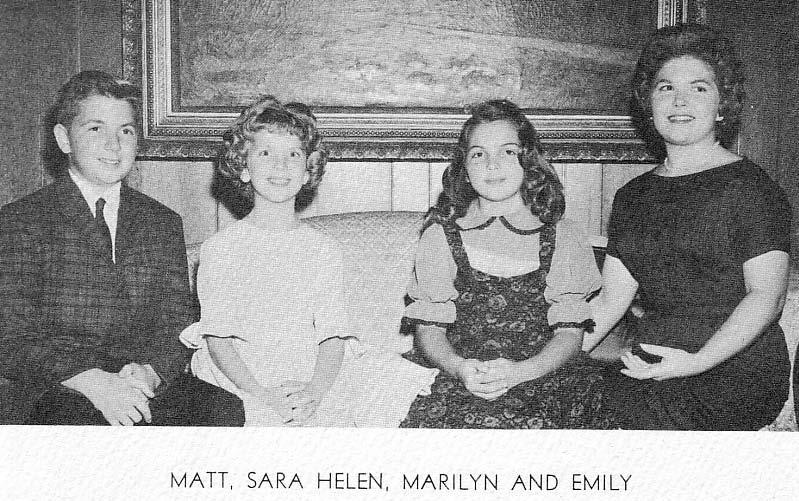
We went to church at the Vermont Avenue Church of Christ. We could walk there from home, because it was at the east end of the Pepperdine campus. College students always attended church there, and we girls liked knowing them. Helen and Norvel usually sat down front, in the second pew on the left. Norvel would often write an article for Power for Today or 20th Century Christian on a big yellow legal pad, and it was pretty obvious he wasn’t paying attention to the preacher. Sometimes my mom would scold him that he was setting a bad example by so obviously ignoring the sermon. Sometimes Helen was so tired that she would doze off, so she would have Marilyn or Sara sit next to her and rub her hands to keep her awake. Here's a picture of the Young kids around 1963.

I loved it when Norvel would be the guest preacher at Vermont. He was so enthused about what he was saying (which some of our preachers were not). One time he read a long passage from the Book of Acts, where Luke is describing a voyage at sea that he took with the apostle Paul. Norvel read it like he had been with them on the trip and was remembering it all, and he really made it come to life for me. He had such energy and imagination that he made me feel it. That had never happened to me in church before.

When I was little, I liked to sit between my mom and dad, and occupy myself by drawing. We girls also wrote notes to each other. We weren’t allowed to whisper. When we were little, we were required to be silent and sit very still. One thing I did sometimes was examine the contents of my mom’s purse. I found the items fascinating because they belonged to a grown-up lady. She had a dark brown alligator pocket book that zipped close, and a tan lizard skin bag that closed with a firm snap of a clasp. Those were my favorites because of their texture. She always had a tiny red New Testament and Psalms, and I liked to look at the fine print. And she always had Kleenex.

Little children were regularly carried out of services when they made any noise. Sometimes they knew a spanking was coming and starting freaking out in their parents’ arms as they were carried out. My parents didn’t often spank me, but once my mother whispered that she would give me a spanking after church. Knowing it was coming, I ran home, and when she came after me, I somehow had the nerve to run from her in the house as well. I think she gave up chasing me on that occasion.

I can’t imagine why she saved it, or how I found it, but I discovered in her papers a note from 1960. “J.C., Please do not let Gwen go to Helen’s or anywhere to play with children. She’s too tired to be good. I’ve just spanked her for talking back. If you can’t take care of her yourself, send her to the library to me.”

Daddy never spanked me. Momma later said that “he was afraid he would kill you children” if he spanked us. I only saw him rage once, and I can still see myself cowering down at his feet, clinging to his legs, not knowing for sure what exactly I had done wrong, but really feeling terrified. Instead of hitting us, Daddy would talk to us. Once Chip told Momma, “Please just spank me and get it over with. Don’t let Daddy talk to me.” That punishment must have seemed interminably excruciating to Chip.

I don’t know why I was such a “touchy feely” child. My parents were not affectionate or demonstrative, even with each other – I believe I only caught them once kissing in the kitchen. So where did I get the idea that I needed to hug everybody? Once when church was over and we stood up to leave, I reached out to hug Daddy. He stood there immovable as a barrel, allowing me to hug him, but not responding. I felt like something must be wrong with me that he wouldn’t hug me back.

The Young family and mine were always at church every Sunday morning, Sunday night and Wednesday night. That was the deal, if you were a serious Christian. We figured those who showed up only on Sunday mornings, and especially those who weren’t there every Sunday, must not take God very seriously. We couldn’t be too sure about their spiritual status. It was our duty to set a good example for others by making an appearance every time the doors were open. My dad was an elder, so that made our family’s image all the more important. People were watching. It must have been weird for my parents and the Youngs to attend church with people they had to work with during the week, but I didn’t think about that at the time – it was just our world.

One fun part of church-going was that it provided an excuse to eat out on Wednesday night. My mom worked full time but she was still supposed to get supper on the table every night on time. Thankfully, Daddy acknowledged that wasn’t feasible on Wednesday nights, and we went to a restaurant on Manchester Avenue called Du-Pars. It was really a coffee shop with a bar in back, but it seemed fancy to me. That’s where I fell in love with fried shrimp, and that’s where I invented squeezing lemon juice on a roll instead of butter and jam. In all my life I’ve still not run into anyone else who likes lemon juice on rolls. Du-Pars was where Daddy met with his Kiwanis group each week, a schmoozing and service organization for local businessmen. Daddy took me with him to the meeting a couple of times.

As I got older, I would beg Daddy to invite George Hill to supper with us. I knew if the three of us went alone, Momma or Daddy would be quiet or critical or frustrated or something unpleasant. But if George Hill, an entertaining single guy full of energy, went with us to supper, we would have fun. The adults would talk to each other and I could relax.

I can still feel all the feelings that came to me in the Vermont Avenue church building, three times a week for fourteen years. It was an old white stucco building. The wood trim was all dark brown. The pews were dark brown wood, padded with something like brown Naugahyde, or some other plasticized fabric. There was a central aisle, and an aisle on either side of the building. The side aisles were arched, like a smooth, rounded adobe house in the desert. Supporting the interior curve of the arches were round columns, with simple capitals connecting them to the main ceiling. This created a cloister effect on the side aisles. There were plain, round, brown metal chandeliers, with candle-like light bulbs, hanging down the center aisle of the building.

The church had stained glass windows, with no pattern or picture but a crazy quilt of pastel colors in all kinds of shapes. The stained glass artist or artists must have used broken pieces, fitting them together with the leading. I loved those windows. I loved how the Sunday morning light streamed through them. My dad loved stained glass so much that he had lights installed outside so we could all enjoy the colors during the evening services.

I loved the cool, calm feeling of sitting in that building during a service. It was quiet and safe, and the songs were beautiful. The congregation was mostly educated people, and the hymns tended toward a classical style. “O Sacred Head, Now Wounded,” “The Lord Is In His Holy Temple,” “Now The Day Is Over” (Marilyn loved to hear me sing the moving tenor part an octave up), and “Be Still My Soul” gave a sense of reverence to our worship. Dr. Earl Pullias, who had been a Pepperdine professor and now taught psychology at USC, sat on the fifth row back. I was told that he had been a big influence in our song leaders choosing the more dignified of the hymns.

I didn’t realize it growing up, but we looked down our noses at, or felt pity for, the little country churches, and the churches back in the South, the ones that sang the foot-stomping, thigh-slapping “oom-pah” songs. Those kinds of songs, we felt, lacked “reverence” but really we thought they mainly lacked class. In college, I finally discovered them for the first time, and I loved them. My boyfriend’s parents had a hymnal full of what they called “Stamps-Baxter” songs. (I believe that was the name of the publishing company.) The energy and joy in those songs fit my overflowing heart, newly baptized in the Holy Spirit. I am deeply grateful for all the hymns that shaped my childhood.

My beloved childhood preacher, Gordon Teel, told a story about a little congregation where the preaching was truly terrible. He noticed a little old lady who was faithful to attend week by week, year after year, and he, being a young whippersnapper at the time, asked her what kept her coming back. “It’s the hymns,” she said, “the theology in the hymns is so rich.” And it was for me too. The hymnal we used was a blue cloth-covered book with a blue string place marker, called Great Songs of the Church. When we were children, we didn’t realize that it was a collection of songs and hymns from many denominations. I still love that hymnal. It became my friend. I grew familiar with the names of the hymn writers and learned some of their histories.

In our tradition, the song leader would tell us the number of the “invitation hymn” before the sermon started, so we could find and mark it with the string. This was intended to make the transition from sermon to song smoother. It occurs to me that this was a technique intended to remove distraction, to produce an emotional effect, which the movement traditionally resisted doing. There was such concern that someone might have a merely “emotional” response to God, one that wouldn’t last, that we discouraged any emotional experiences at all in church.

After Gordon Teel had moved to another congregation, I didn’t like the preachers who followed him in the pulpit. Part of that was my age and my growing discomfort with our doctrine. I would occasionally read the Bible, trying to avoid criticizing the sermon in my head. How shocking it was to have my mom correct me for reading the Bible in church! She said I was supposed to be listening to the sermon. I found this bizarre, to be scolded for reading the Bible.

There were two chairs facing the audience on the platform where the pulpit stood. That’s where the song leader would sit between prayers, and where the men would sit who were making announcements or praying or whatever. As one of the elders of the church, Daddy went to regular meetings where they discussed budget, building maintenance, the preacher, the Sunday School, whatever they felt needed attention. An odd memory is that Daddy would get nervous about speaking before the congregation. Because he would cough when he got nervous, he kept a bottle of Terpinhydrate with codeine in his suit coat pocket to swig on. This habit seemed so opposite to my parents’ usual concern about what other people would think. My folks would never go in a bar or order wine in public, though my dad did keep a bottle of wine in the back of the refrigerator. He said a little shot glass of it helped him sleep. His conscience was clean because they had lived in Europe where people regularly drank with their meals, without the stigma American Christians put on drinking. Most Europeans didn’t drink to get drunk like Americans did.

In Sunday school it was a really big challenge to memorize all the books of the Bible. I think it was around fourth grade. That made it easier to find scriptures when we were looking them up in church and in school. We learned a lot of Bible stories. One Sunday School teacher was a college student, a gentle young woman named Dorcas Traylor. I knew the story of Dorcas from the Bible, what a good and generous woman she was, and this only heightened Dorcas’ stature in my eyes.

Once Dorcas asked us all to say who we wanted to grow up and be like. The other little girls went first, and each one said, “My mother.” When it was my turn, I said, “I want to grow up and be like you.” I was embarrassed to be the only one who didn’t want to be like their mother, but I also was a truth teller. I didn’t want to be unhappy or make other people so unhappy. I wanted to be nice. I had no idea that later Niceness would become an idol to me, and I would have to repent of worshiping it.

Knowing Helen Young in my growing up years moved my life closer to God. When we were little, our Wednesday night class was only Marilyn, Sara and me, and occasionally one or two other girls, so Helen decided to teach us instead of making us sit in church. We sat in little chairs around a table, and Helen talked to us. I remember feeling so special because an adult took the time to talk to me. My parents were always too tired or too busy or something. They never just sat and talked to me. Helen chose to take the time to impart things to her girls, lessons, family history, all kinds of training.
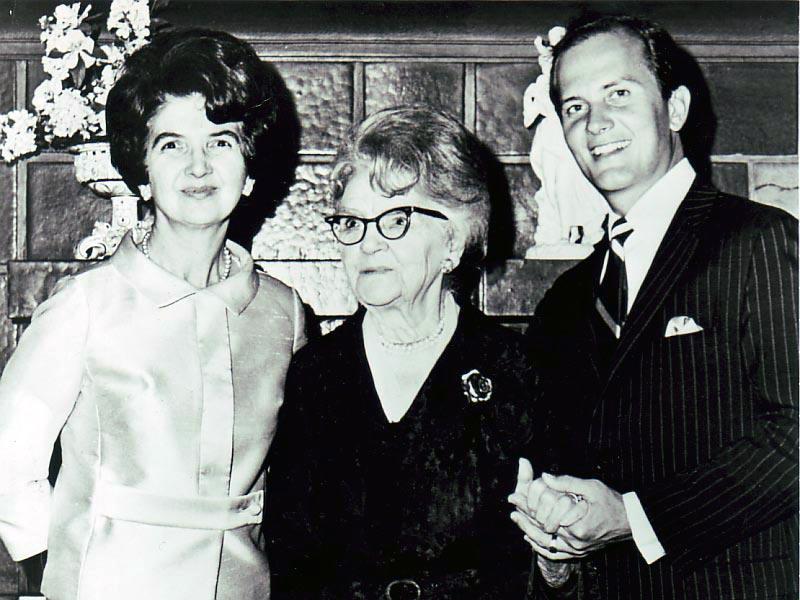
Here's a picture of Helen with her mother, Irene Maddox, and Pat Boone, taken around the time she was teaching our class. One of those Wednesday nights she talked about her mother, Irene Maddox, and she cried. I found out later she almost always cried when she talked about her mother. That night I learned a lot from watching and listening to her. I learned that it was okay to feel tender feelings and show them. I learned it was good to honor your parents and respect their example. I learned that when someone else has a close relationship with God, it makes you hungry to know Him better too. Both Mr. and Mrs. Maddox helped Helen want to know God, and she helped me to want to know God. She told us how her father was too old to play with her when she was growing up, but he helped her memorize whole chapters of the Bible. She said that this heritage meant more to her than if he had left her a fortune.

There was a “cry room” where mothers could take their babies and toddlers, up some stairs at the entrance to the church with a big plate glass window overlooking the congregation and a speaker system so the mothers could still hear the service. That’s where they put our Sunday School class for many years. One of our teachers, Ernest Shaw, had a boy and girl in our class who were shy, or at least quiet. We didn’t ever get to know them well. Mr. Shaw came to my dad once and told him I was prejudiced. I’ll bet I was, because later when I became sensitized to prejudice, I realized that my dad was really a racist. He was a product of a small east Tennessee town, even though his family had moved to Memphis, Mississippi and Nashville by the time he reached high school.

When we got older and found out that other churches had youth groups, we felt deprived. It was always hard for the elders to find teachers to teach our age group (no matter how old we were!) and I remember several adults and college students giving it a try. We were a tough audience! We were pretty critical and cynical, even more than is usual for teenagers, and very hard to “reach”.

We had one teacher who really tried hard, Jim Atkinson. I remember his seriously trying to teach us the book of Romans. When we got to the passage where it says God is like a potter and we are like the clay, and He can do with us whatever He chooses, it made me mad. I argued, “But surely God has to be fair! Surely God has to keep His promises!” I couldn’t handle it if God were like my parents, unpredictable and seemingly arbitrary in the way they acted. God just had to be different. I desperately needed Him to be dependable.

We probably hurt Mr. Atkinson’s feelings because we thought he was so uncool. His favorite word was “keen”, as in, “That’s really keen!” and we were so embarrassed for him because nobody said that word anymore. It had been popular maybe twenty years before. Once we were discussing popular singers and the name of Barbra Streisand came up. By that time, I had become aware of racism and prejudice. Mr. Atkinson told us that Jews like to spell their names differently than other people, and I got mad at him because I thought he was making an ethnic slur. I also scolded my mom for talking about “Jewing someone down,” by which she meant bargaining for a lower price.

Duane Doidge (a fraternity brother of Chip’s and Matt’s and Danny Jackson’s) taught our Sunday School one semester, but he gave up on us after not too long. Harry Skandera, another fraternity brother, tried it. No one ever really succeeded. I was so offended by one of our teachers. Bill Stivers was an elder, a professor of Spanish at Pepperdine, and led regular mission trips to San Felipe in Baja, California, and he taught our class for awhile. In a discussion on prayer, he said, “Prayer doesn’t really do anything to change God’s mind. It’s good for us psychologically, and that’s why we need to do it.” I was horrified, and thought the poor man had no faith. I believe I told him how that upset me.

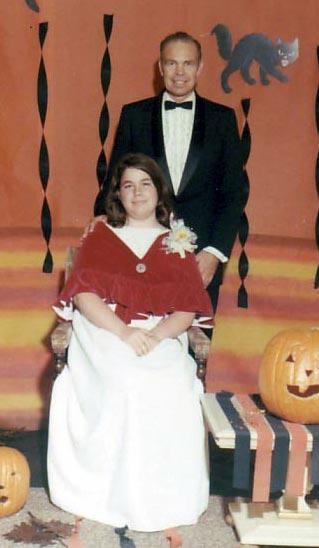
Mr. Stivers caught me walking home after church one day and confided in me that his daughter Nina was not turning out as ladylike as he thought she should be. He asked me whether it was a good idea to buy her some false eyelashes and makeup. I heartily discouraged that. I didn’t like it that he was asking me for advice, and I didn’t like it that he wasn’t content with his daughter just the way she was. After my dad died, when I was sixteen, oddly enough Bill was the one I invited to take me to a father/daughter banquet. I guess he was the only man I thought could “act the part” and not be too uncomfortable escorting me…I perceived he had some compassion for me and wouldn’t mind too much. Below is a photo of Bill and me at that banquet.



Monday, October 03, 2005

I’ve introduced you to Charlie Lane before. He was the British night watchman who patrolled the Pepperdine campus all alone for many years. He was a beloved campus figure, and did his job with utmost dignity and dedication. The Watts Riots in 1965 had threatened our peaceful Los Angeles oasis, but had not directly affected us. A couple of years had passed, and though many burned out stores had not been rebuilt, and there were still outbursts of racial tension in the city, most of us were not conscious that it could impact the campus. Then one night, a few young boys were loitering around Mr. Lane’s car. Apparently, he felt threatened enough that he removed a gun from inside the car and laid it on the hood. The report was that one of the young men grabbed the gun and, in a struggle, it fired and killed him. Mr. Lane affirmed to everyone that no one shot intentionally, that it had been an accidental death.

The family of the young man were Christians, and they struggled to forgive and remain at peace with Charlie and with the institution. But the emotional and political tension in the neighborhood erupted. The Black Panthers, US, and other black power organizations threatened the physical plant. Someone received a message that the campus would be burned down. There was a small fire backstage in the auditorium, and no one knew for sure if it was accidental or had been set by arsonists.

Doors to the major buildings were chained and padlocked. Small groups of students gathered in clumps and moved from place to place, discussing, arguing, planning action. At one point I was in the middle of a small but heated crowd and heard some of the strident voices and the violent emotions being expressed. The black students on the campus were under a lot of pressure to stand with their brothers and sisters in the community, yet some of them with a deep faith were determined to be peacemakers rather than revolutionaries. Cathy Meeks was one leader toward reconciliation. I was blessed to run into her again in Nashville some years later, when she had become a published author on the subject. In 1967, she said something like, “I believe I am called to lay down my rights, not fight for them. If I’m to suffer or die, I want it to be for Jesus, not for retaliation or for my civil rights.”

I hurried from that student gathering over to the Youngs’ house and there in the living room lots of folding chairs had been set up and were full of men in suits. TV news people, newspaper reporters, photographers – who knew who they all were? Dr. Young had me run to the study and type a press release. It felt so good to be useful in this crisis, and it felt really good to be near power at a moment like that. I had felt so powerless and without a voice, standing in that crowd of students, and now I had a function.

I think it was Duane Doidge, a friend of Matt’s from Texas who had taught our Sunday School class, who drove us over to McDonalds. It was so much fun ordering fifty Big Macs and fifty orders of fries to take back to the Youngs’ house to feed the news people. They hung around for a couple of days at least, possibly longer, awaiting news of whether Pepperdine would call in the National Guard. Dr. Young won the respect of the community when he rejected the pressure to let them come, stating that we were a part of our neighborhood and would work out our difficulties on our own. I was proud of him for refusing to use force to protect the campus, since the presence of the National Guard would have inflamed and polarized the atmosphere further.

Poor Charlie. He was asked to resign, for his own safety and to defuse at least some of the volatility. We kept in touch with him for several years, visiting him and his wife Kit from time to time. He was never the same. His dedication and love for the students and the institution had been so deep. He must have felt betrayed, though he struggled to forgive and accept what had happened.

I was a sophomore at Morningside High School when this happened, and of course had already been sensitized to the racial tensions in my schools, my city and the country for several years. I found an angry note from a black student on my desk in Biology class one day. For some reason I wanted to engage in dialogue instead of ignoring it. The writer of the note didn’t answer, but another student also hungry for understanding responded. The note read: “BSU is on its job to help Black students get themselves together against racist pigs.”

I wrote, “Hey you! Could you tell me what you mean by together? As long as you call anybody a racist, or a pig, or a nigger, or a kike, or any other label, it’s easy to hate, to shout and to even kill – and it’s impossible to get anywhere in understanding people (which is the only place you start to get freedom, to get a good life). Sure, hating is a lot more fun than not caring at all. But hating is not the answer to anything. Please don’t call me a racist or a pig – and no matter how much bad happens to you, try not to hate back. That brings NOTHING BUT BAD.

I try to meet every single person (no matter what color) as a single person. A white person (that really is acting like a pig) isn’t the spokesman for every white in the world any more than somebody you’d call an Uncle Tom or a separatist or a black racist (that’s what I mean) would be an average black. Some people react to a bad experience, or even a whole lot of them, by saying, “See, that’s the way they all are!” So we’ve both got to watch it. Write back, okay?”

And someone did. “I’ve read this and understand it. It seems to be true. I am Black and proud. When a Black person says ‘together’ or refers to someone as having a ‘together’ mind, we mean the opposite of what you said up here. (She drew an arrow to my words ‘Uncle Tom.’) My definition of ‘together’ is a Black brother or sister or maybe even a white person that is all for their people and they know how things really are for people that are not the same as them. Someone that can really comprehend and not only eat these things that are going on but also digest them and gain something and not be afraid to talk about them, as I would say, to talk heavy.

“I don’t sit here where this seat is, but friends of mine read this and I was curious too! They wouldn’t have written you back, so I am because I think that you have a pretty together mind. I’m a sister, my name is Toni Davis, and I’m a sophomore. I have this class fifth period. I have tried to get into the BSU (Black Student Union) at our school and they asked me if I have ever been in the organization called ‘US’. This organization is now a group of Black racists (as you say), pigs, Black pigs. I call this group pigs because they steal from the Black man. I know you say, ‘Just how do we steal from you guys?’ Well now let me answer that. The white man has already stolen from my people, they have stolen from them 300 years ago, they have demolished the Black man’s good reputation of contributing to the world as well as the white man. Do you know that I am 15 and can’t really tell you anything that would last for 15 minutes about the Black people. This is why I have tried to join the BSU. But they turned me down because they thought I was in the US organization. I was not. But they turned me down. Just like you said, you can’t judge a person by other people. Understand? I’m trying to say that they judged me by the rest of them. They did ask me if I ever associated with the US organization and I replied, ‘Yes.’ I have, but I have only gone to their dances and have attended a few public meetings. I’m going to try and get in again on the next screening, this time I’m going to get them together! On me! I think that you are the kind of white people that need to join the BSU also. Please write me back, ok? What’s your name, grade, I already know your race (white?) and sex, male or female. You sound and write like a girl. Bye! Toni”

We continued our odd, faceless correspondence through a series of notes. We never met, but I felt I had made a tiny breakthrough, a small movement towards racial understanding. In our high school, there was a walk-out of most of the black students one afternoon. We understood that they were expressing the anger of the times, but some of us felt it was a bit inappropriate for these middle class black kids to act as if they had personally experienced the pain of racial prejudice and poverty as others had. (I hadn’t heard the concept of solidarity at that time.) Usually, my overtures toward starting a conversation with black girls at my high school were met with angry mocking and harsh rejection, including the word “honky”.

Life in the city was intense, even though we tried to maintain the illusion of our little Southern enclave on the Pepperdine campus. But there were many wonderful places of escape, both beach and mountains. Every summer the Churches of Christ would hold a week-long vacation/revival event called the Yosemite Encampment. Families would come to play in the national park, but there would also be sermons and children’s classes and the goal was spiritual edification as well as relaxation. That’s where I learned the children’s hymn:

“When He cometh, when He cometh to make up His jewels
All His jewels, precious jewels, His loved and His own,
Like the stars of the morning, His bright crown adorning,
They will shine in their beauty, bright gems for His crown.”

Looking back, this was a rather weird image to teach a little child. Yes, it told us that we were lovely, and precious to Jesus, but in what way would it be a good thing to become a part of someone’s crown? At any rate, I could feel the tenderness that was in the teacher’s voice and heart. She gave me an inkling that Jesus felt that way about kids.

Once at Yosemite, I was with the Youngs, and we were playing in the river. There was a shallow part of the river where it was safe for us little kids, and we were splashing around and having a good time. All of a sudden, I lost my footing and went under the water. It was all green, and the water sounded weird in my ears, and I didn’t know how to swim. Helen Young came crashing into the river in her clothes, and grabbed me. She rescued me from drowning. I felt so bad because she had on a watch that was ruined. Someone explained that there was a drop-off where the river got a lot deeper, and I must have stepped off there.


I went with my parents for a Pepperdine retreat weekend to a place called Camp Tanda at Big Bear Lake. We slept in cabins that had a few wooden steps up, and then a wooden floor and walls about three feet tall. From there, the walls and ceiling were all canvas tent. You could tie the wall flaps up like windows all around the cabin. I think they were left over from World War II. Anyhow, at Camp Tanda there were all these cabins in the woods, and then a big building called the Lodge, and next to it a swimming pool and a canopied eating area with lots of tables and benches.

I was in the swimming pool and a family friend named George Hill tried to teach me to swim, but I didn’t trust anybody not to let me drown. Where did I get my fear of drowning? It wasn’t the episode in the river at Yosemite where I almost did drown. It happened before that. Early on in our time in California, we all went out to the beach at Playa Del Rey, and I was having so much fun jumping in the ocean. I was still short enough that I came up to my dad’s waist, I guess, and he was picking me up by the arms and helping me jump over the waves as they rolled in. I loved to feel the power of the water crashing around me. And I wasn’t scared, because my daddy had me.

But suddenly, a wave knocked us both down. He let go of me, and I could feel myself being sucked away from him. I was under water part of the time, and on the crunchy sand with the water rushing away from me part of the time. I had a hard time getting up and getting back to shore. Somebody explained that sometimes at that beach there was this thing called an “undertow” and it meant that it was hard for even an adult to swim back to shore.

Camp Tanda was the first place my parents ever sent me away to. I was scared to be on my own, and I didn’t want to go. Such a misfit child, I had not yet learned the art of approaching a stranger for conversation, and I stayed lonely the whole week. The last night there, our camp counselor let us go into the dormitory kitchen and make popcorn. Someone put way too much butter in the popcorn. I woke up for the first (and thankfully last) time of my life, throwing up. Since I was in a sleeping bag, this was quite gross. I’ve never wanted butter on my popcorn again.

The second time my folks sent me to Camp Tanda, it went better because I knew some of the kids. Marilyn and Sara were there, and Janice Hahn and her cousin, Jackie Stalcup. This time, some of our counselors were college guys that we actually knew from Pepperdine. I had a classic teenage catastrophe when one day, one of the college guys was sitting with us at our lunch table under the canopy, and he said something so funny that I snorted with laughter. Unfortunately, my mouth had been full of milk at that moment, so it came out my nose. Mortification was fast becoming my middle name.

That week at camp, I had the privilege of seeing into Janice’s heart. She was always funny, always up, always “on”. But something had happened to sober her, and she was sitting alone by the campfire. I walked over and sat next to her on the log, and asked her if she was okay. She was having a most unusual tender moment. She trusted me enough to say, “Do you know what it’s like to always be funny, and everybody expects you to be, but when you want to be serious for a minute, nobody understands?” I really didn’t know what it was like, but I was honored that she would share it with me. I had not yet felt the joy of making people laugh.

One of the Pepperdine staff was a leader at that camp. Toward the end of the week, some of us teenagers felt very touched by all the Bible classes and worship services in the midst of nature, and a couple of kids asked to be baptized. They were, and we stood afterward in a circle in the dark, holding onto each other and singing songs and hymns. One of them was “O Happy Day.” The moment was very holy, and that staff guy, Bob Fraley, crashed into this tender time after the baptism by announcing refreshments and breaking us up. This event marked the beginning of a growing awareness of my sensitivities getting stomped on by insensitive people. That trend continued offending me for many, many years.

Camp Tanda was also the location of choice for Pepperdine’s Freshman Orientation. Each fall, my folks and I would go up to take part in that weekend, and all the freshmen were required to wear a bright green beanie with an orange “P” on it. They were supposed to keep on that beanie for awhile after returning to the Los Angeles campus, too, to mark them as freshmen. I think it was a hideous six weeks, at which point they celebrated the beanie’s retirement at a Freshman “Coming Out Party.” Thankfully, by the time I became a Pepperdine freshman, the beanie tradition had been retired.

Jennings Davis, Pepperdine’s Dean of Students, was a tender-hearted Southerner who had transplanted his family to our block, West 79th Street. Each fall, as a special treat during Freshman Orientation, we would all walk down to the lake near Camp Tanda, and stand around together in the moonlight while he recited, in Southern black dialect, James Weldon Johnson’s poem about Creation. (Decades later, I met another person – my favorite boss, Rabbi Davis at the Temple – who knew that poem and quoted from it. He thought it was pretty cool that I recognized it and could tell him the author’s name. He nicknamed himself “De Lawd” from that poem.)

There was the cutest guy named Gordy Howe, a leader at my own personal Freshman Orientation in 1970, who is the only other person I’ve ever met who could recite parts of Stan Freberg’s The United States of America: The Early Years . . . and did! Camp Tanda is also where I had my first and only snow ice cream one winter weekend. I hated it because whoever made it put in way too much maple flavoring.

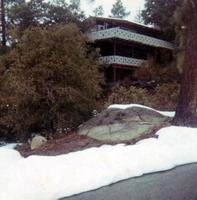
Another strange nature experience which occurred at Camp Tanda is still engraved in my mind. There was an enormous tree that had a hollowed out place at the base of the trunk, and someone had put a stone there which had been eroded into a bowl-like shape. That’s where a large bull frog liked to sit, and some older guy wanted us to see him. It so happened that while we were watching, a snake decided the frog would make a nice lunch. He stretched his snake jaws wide enough to take the frog’s head entirely into his mouth, and we watched as the air inside the frog made his hind quarters blow up like a balloon. I guess we weren’t afraid of the snake because he was clearly preoccupied, and that fascination with the horrific kept us glued to the scene.

I’m not sure when we first visited Idyllwild. It was sometime during my grammar school years. It didn’t take us long to find a cabin that my parents decided to buy. We met a real estate man named Joe Merrick who helped us find it. He and his wife Marion were so nice to us, they started inviting us over to their house sometimes for dinner. They lived full time in Idyllwild, in semi-retirement. Marion was a painter, and I still have a tiny oil painting of the high desert that we bought from her. They loved to watch the squirrels, and feed the birds. She introduced me to Indian pudding, which she made for our supper one night.

It took us about two and a half hours to drive from L.A. through Riverside and up into the San Jacinto mountains, near the Mt. San Jacinto State Park. On the other side of our mountain was Palm Springs, where all the movie stars went to vacation. On that side of the mountain it was desert, but on our side of the mountain it looked a little bit like I imagined Ireland to be. Lots of rocks and boulders, with lots of green, especially in the spring. The further we drove into the mountains, the more trees there were, until when we got to Idyllwild we were really in the woods.


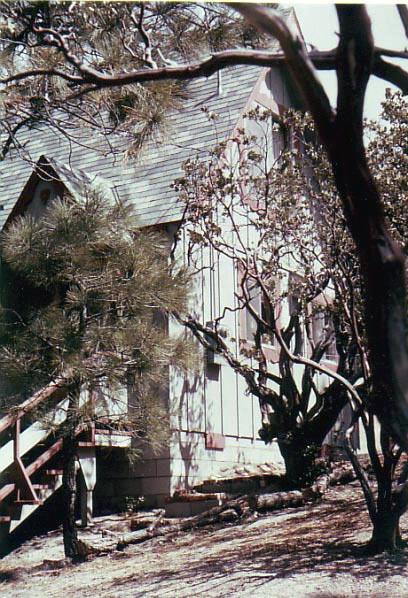
The cabin was a small A-frame house built on a steep hillside, so the front side of it was high off the ground while the back side of it had a much shorter foundation. There were stairs as long as a whole staircase up to the front door. You entered the kitchen, then to the left was the living room and a sliding glass door out to a balcony. Up some more stairs was an open upstairs loft-style bedroom. It was really all one big room except for the single downstairs bathroom off the kitchen.

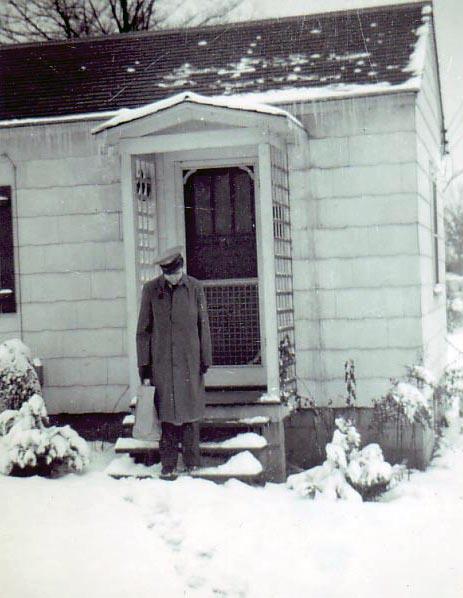
There wasn’t a fireplace in that cabin, but Daddy loved fires so much that he had a modern, free-standing black wood-burning stove installed. Downstairs we had the old brown couch that made a bed, that had traveled with them all the way from their first house. My parents had built a one-room house during the War when they were newlyweds and he was stationed in Tullahoma, Tennessee at Camp Forrest. We heard a lot of stories about the adventures they had building and having company in that $500 house. Here's Daddy on his way to Camp Forrest in the snow. I've actually been to see the tiny house and it's still standing!


That enormously heavy old brown couch, a big table and benches, a bookcase and a couple of chairs filled up the living room. Upstairs there was a double bed for Momma and Daddy, and two twin beds under the eaves for Chip and me. If you weren’t careful when you sat up in those twin beds you would bang your head. I absolutely loved the feeling of security I had when all four of us would lie in bed at night and Daddy would play the ancient brown radio by the bed. He loved to listen to music from the Big Band Era. (I called it Lawrence Welk music because that was all I knew at the time.) We would all be lying there in our beds, cozy and safe, and enjoying the music together, and I would experience the closest thing to peace I ever felt as a child.

For the kitchen in the cabin, we had bamboo-handled silverware, beige pottery coffee mugs with brown rims, orange and green plastic plates, and those brightly colored aluminum glasses that everyone seemed to have then. One day Daddy and I shopped at the local hardware store and brought home a white teapot with pink roses that played “Tea for Two” to surprise Momma. Another weekend, he decided that he and I would make a lemon ice box pie, and I was amazed that he knew how to cook something. That was the first time I learned about Eagle Brand Sweetened Condensed Milk, and I couldn’t believe anything could be that rich. Another time, Momma made French onion soup, and I said, “I see the onions, but where’s the French?”

It was a Saturday afternoon at that cabin when I began reading my first big grown-up novel, Dear and Glorious Physician by Taylor Caldwell. I sat reading for hours at the table between the kitchen and the living room, while the grownups went somewhere. That was my first experience of the power of erotic literature. I felt shocked and yet stirred at the descriptions of a Roman banquet. It was a good thing that it was the young hero’s first time to be exposed to the atmosphere of an orgy, too, because he and I were feeling the same things. I didn’t want to tell my parents what I had read, because I felt pretty sure they would take the book away from me, and I wanted to finish it, but it felt like a guilty secret. Often in the mountains, I read old copies of the Reader’s Digest.

One time Momma brought a record album from the Pepperdine library. It was Hal Holbrook reading tales from Mark Twain. One in particular made a huge impression on me, and I wish to this day that I could find that recording. It was called “Blue Jay Yarn” and it was the funniest stories I had ever heard. An empty cabin stood in the woods, and a whole crowd of blue jays spent a very long time trying to fill up a hole in the roof of that cabin by dropping nuts, one at a time, through a knot hole. (Of course the joke was that they could never fill that hole because it was the entire cabin below.) Mark Twain was hilarious in his depiction of the personalities of jays.

Once, when we arrived in Idyllwild, the road was so thick with snow that we couldn’t drive all the way to the cabin. And I had on a cast because of a broken foot. Years later, I found out that Marilyn remembered helping pull me up the driveway, sitting on our old German sled. She had come with us on that trip to keep me company. If not for the seasons in the mountains, I wouldn’t have known much about the seasons of the year. When it was spring at our house in L.A., the only way you knew it was that the trees had a combination of the fresh light green leaves and the older, darker green leaves. There was never a fall when all the leaves came off the trees. When I was a kid, it truly “never rained in Southern California,” like the song said. The climate has dramatically changed in the years since then.

The front stairs of the cabin were steep, and once I stumbled at the top and went rolling, falling down all those stairs to the bottom. I was not hurt, and that was amazing, but I sure felt dizzy and embarrassed. One of my favorite things about being at the cabin was getting to make some of the noise I couldn’t make at home. It was so satisfying to take a hammer and wander around the cabin, hammering in all the loose nails that had begun working their way out of the wood. The balcony off the living room had plenty of them for me to pound. Very therapeutic.

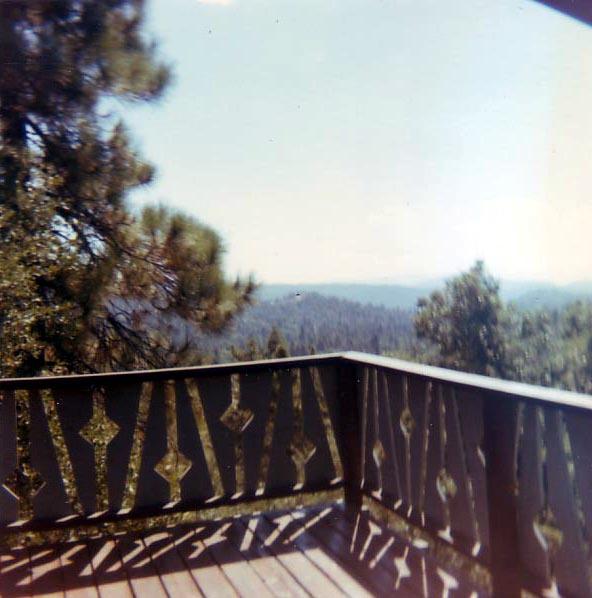
Since I had been living in L.A. for a few years now, it was a revelation to me to sit out on that balcony and just be still and listen. Sometimes you could hear mosquitoes buzzing, other times the woodpecker’s drilling would echo through the woods. Next to our cabin was a little canyon coming down from the snow caps way up above, and in the spring, our creek was really loud with snow melt-off running down the mountain. It had some water in it year around. Just at the level of the cabin, maybe 100 feet away, was a small pond that had been hollowed out of a boulder by the waterfall hitting it from above for years. I claimed it as “my” pond. Above it, at the level of the waterfall, there was a hollowed out place where we made a fort of branches and rocks.

If you followed the creek up the mountain on a hike, you found huge slabs of decomposed granite. In the spring, the runoff would cover the rocks in sheets of water, and everywhere would be tiny wildflowers. I loved to go exploring then. I never learned the names, but I can still see the tiny white and yellow and purple flowers. The names of the larger ones I did hear, but I only remember purple lupine, tan yucca and manzanita.

Manzanita was a kind of tree we’d never seen before we came to those mountains. When it was fresh and alive, the bark was a dark red. It peeled back like skin, very thin, and underneath was a bright green wood. It was almost impossible to break a limb that was living, but when manzanita died it became an entirely different creature. Then it was very brittle and spiky and gray, all curly and curving like a bunch of ten-point bucks’ antlers, and you could much more easily break it.

I had a recurring nightmare, where a lady dressed in long white, flowing garments is ahead of me, with her back to me, but she’s beckoning me to follow. She’s moving through a densely packed forest of dead, white manzanita, and the branches part for her and then close again behind her as she passes. She wants me to do the same. I don’t want to follow her, but I feel compelled.

I loved to hike up a dirt road that Daddy called the “fire road”. It had been cleared for the firefighters in case of a forest fire, but they never had one while we owned that cabin. Way up that road was a clearing with a huge boulder that had been split in two. It was way taller than two adults, and you could barely squeeze between the crack and walk through the two pieces of it. I felt like it was “my rock” and I would take visitors up to see it. I loved to get up that high and look out over the whole valley below us, with row after row of blue, soft-focus mountains in the distance. It was a gorgeous place to watch the sunset, or just sit and listen to the wind as it passed your ears. I never heard such a beautiful near-silence, before or since.


I learned about “wildlife” at that cabin. We developed a mouse problem at one point, and put poison and traps out for them. When we would arrive for our monthly weekend visit, Daddy would go in first to see if there were any mice in the toilet. He explained that they would eat the poison, then jump in the toilet because it made them thirsty. When didn’t we close the lid? I don’t know. We also developed an ant problem, and I discovered that ants in that forest smelled like the rosin of pine trees when you crushed them. They were big, brown ants, and they were persistent and hard to get rid of.

Sometimes we would decide to walk downtown on a Saturday afternoon. Downtown Idyllwild had a hardware store, a market, a movie theater and some little shops. Our favorite was called the Grey Squirrel. That’s where I was introduced to the scent of Claire Burke’s “Fontana” which I loved and which is no longer on the market. I bought violet scented perfume there for Grandmommie because she loved violets. Momma bought clothes there from time to time. It was both a gift and clothing shop, and they always had so much to look at that pleased me.

Once, we were taking a walk in the afternoon. There were some visitors with us, and I was still relatively young. Whoever was walking with my parents, they were up ahead of me, and I couldn’t seem to catch up. They were busy talking, and maybe they didn’t even hear me, but I was yelling, “Wait for me! Wait for me!” and actually got scared they would leave me, and angry that they wouldn’t pay attention and slow down. The moment had a nightmarish quality to it. I was in the grip of a stronger fear than would have made sense.

We sometimes took walks at night too, and for some reason I was never scared then. I loved the woods at night. I loved the incredible blankets of stars, so clear and bright like you could never see in the city. I loved the smell of wood smoke from people’s chimneys. I loved the festive feeling of holiday that we were doing something together, that we were sharing a magical experience. It was fun to have hot chocolate with marshmallows when we got back to the house after a chilly hour.

We hardly ever went to the movies as a family, but I’ll never forget the one time I heard Daddy laugh so hard that he cried and had a coughing fit. It’s a Mad, Mad, Mad, Mad World starred Carl Reiner, Sid Caesar, Buddy Hackett and Shelley Winters and about eight other famous actors, and they defined the word “madcap” in their antics, trying to outrace and outfox one another across the country for some kind of fortune or reward. I just didn’t know my dad had much of a sense of humor until that night when he couldn’t contain himself.

The rides there and back, the two and half hours in the car, I often spent sleeping in the back seat because I got car sick when I was little. But as I grew older, I realized that it was the most time I ever spent with my parents when they weren’t working, sleeping or talking to other people. Sometimes our tensions spilled over into those rides, but sometimes I had fun just being with them.

On some of the drives between L.A. and the mountains, we would pass through orange groves in bloom, and the perfume was the most delightful thing. Once on our way down from the mountains, we visited friends in Riverside, and there were miles and miles of fruit orchards outside their house. I was amazed to learn that they could walk outside their door and pick peaches and apricots. On another weekend we stopped in Pomona at the public library and Momma showed me the Laura Ingalls Wilder collection. Laura Ingalls Wilder was my hero – I read each of her books from the Little House on the Prairie series many times through.

I especially loved Farmer Boy because it explained so many different tasks in just the way Almanzo (later to be Laura’s husband) was learning them, growing up in upstate New York on his parents’ thriving farm. He learned how to make maple syrup from sap he drew off the trees. He learned how to train a yoke of oxen to obey him, and brought logs out of the woods on his own sledge with his own team. I loved to read Laura’s descriptions of food – church potlucks, Christmas dinners, vegetable suppers on the prairie. Those were the days when people worked hard, and burned up all those delicious calories, and I wished I could live then when you could justify all that bounty as fuel for expended effort.

As you may have guessed by now, ours was a family that was in church every time the doors were opened. Weekends in the mountains were no exception. There was a tiny band of Church of Christ people who were meeting on Sunday mornings in a real estate office in Anza, a settlement in the high desert the other way down the mountain. One of the Pepperdine faculty, Wade Ruby, had something to do with that real estate office, so he must have told us the folks in Anza needed encouragement. Dutifully, we drove down there each Sunday and helped them hold a little church service. Sometimes there were more of us visitors than there were of them. The a cappella singing could get pretty rough at times.

Daddy never called what he did preaching. He called it “giving a talk.” He was good at it. He was a thinker, and had some useful ideas about the scriptures we would study. His favorite “talk” which he gave many times throughout my childhood was about a carved stone rosette that had fallen off a cathedral during the many bombings of World War II. He and my mom were visiting as tourists, and they found this broken piece of carved stone lying on the ground. Daddy made a point of walking all around the cathedral to see from whence it might have fallen. He couldn’t spy anything like it anywhere within eyesight. He realized that the workman who carved that rosette had done it for God’s eyes alone. And he encouraged us all to have that kind of integrity in our work and our lives.

After church, sometimes we would be invited to Sunday lunch with an ancient couple we called Brother and Sister Smith. They were wrinkled, skinny, sweet old people who lived there in Anza, out a dirt road in a ramshackle old house. They were like ranchers, only without a ranch. They would make us a big dinner and we would sit and visit with them at the table for a long time afterwards. Here's Bro. Smith with Momma, Daddy and me probably around 1964.

o ~ o ~ o ~ o ~ o

At some point around the time I was becoming a teenager, we sold the first cabin and bought another, which my folks named Traümende – Dream’s End. That name took on a certain bitter quality for me. I came to hate the new place, because now going to the mountains meant more loneliness for me. Chip had left home, first to Heidelberg, then after he married Sharyn, with her to the Peace Corps in Malaysia. Momma and Daddy would sit together on the couch in the evening and look at the fire. I would read, listen to music alone in my room, go for walks alone. Family togetherness in the mountains, such as it had been, was over. Chip and Sharyn are second and third from left, and here they're standing with the other teachers in the school where they taught English as a second language. Sharyn continues teaching ESL today in Santa Monica.

Sometimes I would help Daddy when he was clearing the land around the house. It was his only real exercise each month. He was following the German custom of cleaning up the forest just like you would your own yard. Later on when I lived in Germany as a college student, I was amazed at the tidy, immaculate forest floors. One forest was so incredibly clean it took my breath away. We were waiting for the ferry to Herrenchiemsee, an island near Munich where Mad Ludwig had built a castle. I stepped into the woods by the waiting area and was struck by the silence, the tidiness of the forest floor, and the hundreds of tree trunks that looked like columns holding up the roof of green. I was told it was the job of the older, retired people to do that as they were able.

Back in Idyllwild, the new cabin was so big that it couldn’t properly be called a cabin. It was intended to be their retirement home, I believe. I thought it would be fun to decorate my new room and bathroom, but it wasn’t fun after all because I didn’t like this house. Of course, I was a young teenager, but I thought it sucked. I thought a lot of things sucked. But I didn’t have words for my feelings then. I was just generally miserable, sad and sulky. It was the first time there was enough money that Momma and Daddy said I could choose new stuff instead of using up our oldest stuff. But everything felt cold and impersonal, even getting to buy new things. To this day I still hate lime green and turquoise blue together, because those are the colors we decorated my room with.
I hated the glass-topped dining table that sat on cast iron legs. It was cold and hard and required constant cleaning. The legs didn’t allow the chairs to fit comfortably under the table, and your feet ran into the metal when you sat there. Could it be that I found an object to hate instead of the situation it represented? Sounds like it to me. That table followed me all the way to Nashville when Momma moved here to spend her last days with Alzheimer’s. I gave it away immediately after she died.

Walking into downtown Idyllwild one time, I found a little hippie shop. Feeling the laid-back warmth and seeing the colors and hearing Joni Mitchell playing on the stereo, I felt like me again. I wanted to stay in that atmosphere forever, but Momma and Daddy didn’t feel comfortable there and I was still a child to them, and had to go where they wanted to. One concession Daddy made to my desires as a teenager was buying a tiny portable TV which he let me watch in the downstairs room that was really like a basement. We could pull in maybe one station, and that not very well.

The only show I recall watching down there was Hogan’s Heroes and that’s probably because Daddy came down and watched it with me. He loved Hogan’s Heroes, set in WWII Germany. He loved to laugh at the characters of Colonel Klink and Sergeant Shultz, and possibly also enjoyed the Americans hoodwinking the German officers time and time again, though I’m guessing that because he didn’t say.

On one of the long rides to or from the cabin, Momma had been particularly upset about something and we stopped to let her go into a drugstore to buy whatever it was that she needed. While she was inside, Daddy leaned over the back seat and said to me, “I’m afraid your mother is really crazy.” This was a very unpleasant and disturbing thing to hear – not only that Momma might be crazy, that was bad enough, but that my Daddy, the other half of my supposed security, was afraid of her and confiding in me about it.

The year after Daddy died, Momma allowed me to invite two college boys to go with us on one of our last trips to that second cabin. Mark Weldon and John Kester were friends of mine, and John brought his guitar and we sang by the fire. Kester could play songs by the Association (“Never My Love” and “Cherish”), and all those old folkie favorites of mine, Gordon Lightfoot, Judy Collins, Joan Baez, Bob Dylan, etc.

I took John and Mark on a hike up to “my rock” and showed them everything I loved about the mountains. They had brought marijuana and possibly assorted other chemical assistance with them to make the trip more enjoyable, and that freaked me out more than a bit. I believe my mother never caught on that they were high. Kester gave me a very nice compliment at some point. He remarked, “You always look like you’re just naturally stoned,” and Mark assured him, “She is. She is.”