Showing posts with label Nashville. Show all posts

Monday, August 21, 2006


Now that I was back in the “Buckle on the Bible Belt,” I had figured that I would return to my old ways, showing up at church every chance I got. But I had changed, and times had changed, in the passage of only one year. Now I was a student at Vanderbilt Divinity School (which I’m sad to say I despised, judging it inferior in comparison with Yale), working and living at the Hospital Hospitality House, singing late nights in the studio, and somehow additionally carrying on a new friendship with Marty McCall. Not too much time left over for church. I didn’t know yet to be on the lookout for my extremist tendencies, so I overreacted to my immersion in the life of the mind the previous year and turned now to the life of the emotions, with a heavy emphasis on relationships.
I wrote an essay for a class at Vanderbilt. This isn’t the final version, which I can’t locate, but an initial draft. It’s definitely revealing of “where I was at” regarding my spiritual life. My brief time at Yale had left its mark on my language and my thinking, as is apparent.
“What is it about ‘low church’ worship that is so discordant and irritating, if not merely disappointing? Is it not the inappropriate moments of banality, the intrusion of commonplace concerns and emotions into the realm of what we sense as numinous, holy, awesome? I will never forget my first conscious response to the low church mentality, when at summer camp there was a night-time baptism, and almost before the hymn with words of rejoicing and praise had ceased, the camp director announced that the hot chocolate was ready. Not even a moment of silence marked a reverence for the new birth that had just been accomplished. An extended period of exultation would have been as foreign to that gathering as would a coped and mitered bishop and a marble baptismal font. I have since forgiven the camp director, but the impression made on my worshiping consciousness that night has been deepened by layers of repeatedly incongruous business-as-usual responses to the presence of the holy.
“As I continued along a semi-conscious path toward spiritual integrity, I found myself seeking the fellowship of people for whom worship was not only a vital experience, but for whom that experience was not embarrassing. I sought people who were capable of discussing their response to the Word of God, rather than the dynamism of the preacher or lack thereof; to the love of the Lord, rather than the beauty of the singing or the building or the day. People with whom, though it might be difficult, it was important and possible to communicate awe, and gratitude, and excitement, and acceptance, and — blessedness — in the presence of God. People who knew how to demonstrate their awareness of the shocking reality of worship, of exhortation from the Word of God, of being with one another before Him.
“I went to the ‘high’ churches and found: a respect for ritual and mystery, dignity, and infinite sensitivity to ‘taste’ and appropriateness. I found an awareness of the power of drama, music, visual arts and poetry, to communicate to more than the intellect, to involve the whole person. I found a sense of the weightiness, not only of standing in the presence of God, but of standing in the stream of the tradition of faith, the heaviness of the responsibility to think, to know, to understand, and to consider the meanings of words and actions.
“But I found, too, an uncomfortable, discordant separation between church and street, sanctuary and classroom, communion and meal, worship and party. The presence of God was too easily localized. The language was too easily set within tight boundaries and its use limited severely and strictly to ‘religious’ moments. The attitude of worship, like a pulpit gown or choir robe, or chasuble, or cassock and surplice, was shed at the appointed time and not taken up again outside the doors of the sanctuary. The addition of ritual, language, aesthetic sensitivity, and dignity to the secular mind was a temporary rather than a deeply transforming experience.
“From time to time along the path, I turned to the churches that are lower than ‘low’, that hearken back perhaps more sentimentally than accurately to the meetings of early disciples from house to house. And there I found them – people who could comfortably and often appropriately use their language, their awareness of His presence, their worshipful attitude, their consciousness of God’s particular, complex and all-encompassing claims on the details of their lives, to communicate and experience a fairly constant and consistent and livable, usable, integrated life of relationship with one another, as mediated by the Holy Spirit of God through His Son.
“They are those for whom awe in the presence of the holy is becoming a daily, hourly, expressible and exciting reality.”


All the instruments had been recorded, and it so happened that we were recording the vocals for our first Fireworks album on my birthday, August 5, 1977. We were in the Gold Mine, Chris Christian’s basement studio (he and wife Shanan lived in the house above it) and there was some kind of technical difficulty that caused us to be unable to use the vocal booth in the basement for awhile. So Brown set up a mic by the piano in the living room and we recorded my solo vocal, “Talks with My Father,” a beautiful song that Marty had written but generously allowed me to sing. It suddenly occurred to me that this was the birthday gift to surpass all birthday gifts – my first solo on record. It didn’t go as well as I had dreamed, but then reality never does if one tends toward perfectionism. The harmonies that Marty and Gary sang on the chorus are still some of my favorites. And Marty’s lyrics, as usual, were fantastic.

Holy blood of Jesus,
Spirit, gently seize us
Brightly light the paths of night
And guide our hearts to oneness.

A few months later, Fireworks went on the road without me. I began to learn the difference between soul and spirit, since my spirit was at peace with this decision, but my soul was suffering. I was giving up my dream! How could God ask that of me? Although it was a fiery trial, I knew even then that it wouldn’t have been good for my heart to be the only woman traveling with four men, especially because I loved them and I was so yearning for someone to love me. Along with Marty and Gary, we also had a drummer, Lanny Avery, who was also a philosopher and watercolor artist, and Chris Harris, a Texas bass player who later went on to work with me for six years at Bob Farnsworth’s jingle company, Hummingbird Productions, and then become a producer in his own right.
The night I told them all goodbye, I felt like Dorothy saying goodbye to the Tin Woodsman, the Scarecrow and the Cowardly Lion and going back to Kansas. I thought I was “giving them up forever” in my dramatic way, but by grace I’ve been able to maintain some form of relationship with all of them except for Lanny. He married, became an insurance broker, had twins, and moved to Florida years ago. I still enjoy seeing some of his watercolors hanging on my walls, along with a painting by Vickie McCall, Marty’s wife, and three works by Danny Blair. What an abundance of artistic talent has surrounded my life. I’m deeply grateful to have such a rich atmosphere to enjoy. It speaks to me of the infinite creativity, abundance and life-giving generosity of our God.


When I moved back to Nashville to attend my second year of Divinity School at Vanderbilt, I fully intended to enjoy the Nashville fellowship, get my spiritual feet under me more firmly, and then return to Yale to finish the third year of my Master’s. But that fall of 1976, soon after I arrived in town, I got the promised call from Bob Farnsworth. Could I sing on a session, a commercial he and his best friend Mike Hudson were producing for Home Sweet Home, Chris Christian’s jingle company? That was the fateful night when I met Marty McCall. I had met Gary Pigg earlier, and the three of us were hired for that evening’s work. We had a blend, energy and creativity that was instantly recognized, and were hired for more jingles, then backgrounds on ten albums being produced that year by Chris for Word Records.
One of those albums was the freshman effort of a young girl named Amy Grant. Chris’s engineer was Brown Bannister, the guy Danny and I had sung with in Janice Hahn’s wedding. Brown was a youth leader at the Belmont Church where Amy’s family were members, and Amy was in his youth group. She made a recording of some songs she had written and sung for her classmates at Harpeth Hall prep school, and Brown played the tape for Chris, who played it for Word executives, who gave Chris the go-ahead to produce an album on her. The rest is certainly history. It was in this way that I found myself singing on Amy Grant’s first album. A couple of years later, I wrote a song called “Say Once More” with a friend (I hadn’t met him yet in this telling) and handed it to Brown who chose it for her third album, Never Alone. Marty McCall had encouraged me to write while we were in Fireworks together, and three of my songs appeared on their second album, after I had left the group.
Back in high school at the Dionne Warwick concert, the night I met Burt Bacharach and decided I wanted to grow up and be a background singer, I could have never dreamed or imagined that I could actually do such a thing, or by what a circuitous route it would happen. This opportunity availed itself and my Yale friends said, “Do it! School will always be here, an opportunity in the music business won’t wait.” And I took the advice of youth and left the Master of Divinity program, never to return.
I did work in the music business for ten years after this, singing in the studio and writing songs while office managing a jingle company that also produced records and theater on the side. At that point I determined I had my fill of the demands of being a studio singer. (The turning point came when I was standing for the third hour in the studio singing about “feminine protection” at 4:00 in the morning. That was my last jingle session.) Then followed the joy of producing my own music in three recordings over several years.
What an amazement and a blessing all this has been. I’ve had my regrets from time to time that I never finished that Divinity degree, but have still never determined that there was a career I was sure I wanted for which the degree would be needed. Meanwhile, I’ve been educated by a wide variety of “day jobs”: business-to-business ad agency; neighborhood newspaper; church; personal assistant to two musicians; assistant to the rabbis at a Reform Jewish temple; medical ethics office; and currently assistant to the Dean of Students of a medical school.
But this story must end somewhere, and so I determined to end it where my journaling began, in 1977-78. In the words of Neil Young, “Old man, look at my life: twenty-four and there’s so much more…”

Appendix

7851 Budlong Avenue

Spring, 1971

And now the time has come
to remember so many things.
Family.
Tall Christmas trees and old gas heaters
(“Patty Play Pals” with singed hair)
bathing babies in the attic
and draining the water through the floorboards
so that cracks came in the dining room ceiling

Slumber parties
the guest rooms, always somehow eerie and forbidding
the strange old day bed with faded red tapestry and too many springs
musty attics and moldy damp basement rooms
mysteries and always a little fear
but also elegance and comfort
and the warm feeling of home

Sunday afternoon naps
and then someone in the hallway brushing their hair
the special dressing room, like something in a story
watching old movies or Saturday cartoons
piled up in bed with that amazingly heavy pillow at your back
or just taking refuge from the hordes at a reception or a dinner
hiding in the Bedroom

Shining dark wood and silver, and smiling faces
across the dining room table
running back and forth from the kitchen

Mud in the gardens
the avocado tree with terrific drooping branches
cherry trees in bloom
hundreds of tall daisies, pine cones
the peacocks once upon a time
and still the parrots
Stonewall Jackson and Kettle
some parakeets and once a turtle
numerous kittens
and Buckwheat

Plush wine carpet, old stained rugs
and one floor upstairs that wasn’t seen for year
because it was always covered with clothes

Rearranging rooms, repainting and antiquing
never being satisfied for long

Windows that always banged
windows that always stuck
the clatter of the screen door,
the screech of the backdoor springs
the unmistakable sound of the key in the lock
and the kitchen door swishing open

The impossibility of getting up the stairs
without squeaking (or at least ankles popping)

Sara’s hard bed and MariLynn’s cluttered one
the king-size in the master Bedroom that seemed enormous
(the bed in the wall of the study for when you were sick)

A strange parade of art work
the awful bust of Sara (with white bird strategically placed atop it)
the fiery inferno above Matt’s bed
the “real William Russell”
Eli and Samuel in the Bedroom
the Family in the breakfast room
and the Children lined up over the mantle

Watching Dickie Cavett late at night in the breakfast room
or William F. Buckley or whatever else was Worth Seeing

Classical music blaring from the bedroom
or, just as often, Youth-type noise
“listening to the stereo” at all hours of the day and night
(Sara stepping through the window instead of the door
to float around out on the front porch)

Serving
at luncheons and teas and receptions and dinners and breakfasts
and whatever other imaginable social occasions
feeling official and important, with inside information
privileges as well as responsibilities

Strange people wandering around in the guest rooms
sometimes invading the upstairs
demanding service, or being so invisible and
unobtrusive that they make you nervous anyway

Football long ago in the front yard
(later, with Boyfriends, eating pie in front of the T.V.)
family games of volleyball
and always tennis
(old balls lurking the corners and backs of closets)

Addressing hundreds of envelopes, sometimes in the Bedroom
at least once in the study while listening to “The Messiah”
the annual aroma of Dad Young’s cigars
and Grandmother Mattox’s face powder
typing papers and reports by the dozens
(an ancient scene – last minute homework being done in the family room
when we’re already late for school)

Instant Breakfasts
hot fudge sundaes
black licorice, pretzels and popcorn, pistachios
diet drinks
saccharin
leftover Dining Hall everything

Dreams, ambition, Potential
traumas both imagined and real
cool gray winters (sometimes rain)
and damp sunny summers
school and vacations
Parties and Seminars
College Kids
(who sometimes lowered themselves and became
Friends
but were usually Sub-Ts and their girls
or Homecoming-court-people or cool freaks
or just Older aloof heroes)

Memories of people walking down the driveway
visions of those as yet unmet (and maybe an old one
or two) coming up

Our dreams will be refocused
the center of our lives is shifting
but memories are precious,
and our world remains firm.


*~*~*~*
Peter Pan Summer, 1972

At seven, with a
romantic and stage-struck little heart
I fell in love with Peter Pan
and when I had grown up a bit
(against my will) I told my
Momma one day that I really longed to
play Peter Pan. But not just him —
I wanted to be Wendy, and Tinkerbell,
and all the rest as well.
And she told me,
“Someday you’ll be all those things
to somebody.”
She knew that from experience.
She had played each role
in her lifetime:
the maker of magic and romance;
the mother and the comforter;
the bringer of joy and lightness.
With a tenderness that soothes.
and a strength that upholds, and
challenges, she’d served as a
leader, and shown the humility
of a follower. She’s stood for
other’s rights, and submitted herself
to God.
She has a playful, sweet spirit
that’s too often misunderstood;
a wit and intelligence that’s
sometimes left untapped. So many fine and
useful qualities – but
as is sadly common, because they
are a mother’s, they go unappreciated.
Perhaps most importantly (though one
hesitates to make such a judgment)
my Momma is a lover
of all God’s good gifts.
In this she will always speak to me
of love, and of God. And this, surely, is
most important.

*~*~*~*
Coming to Heidelberg
1972

Coming to Heidelberg—
it was like coming home.
Things had changed in L.A.
Though there were still
many who remembered my Daddy’s name
most had forgotten how it felt
when he was quietly
loving people
and making life prettier, in his special way.

That first Sunday morning
I walked into the room
where we Christians sometimes worship
and sat in the wooden pew
and felt the peace
in a place he helped to build.
The window overhead, round and violet
let in the morning-colored light
and recalled for me the stained glass he loved.
He’d even had stained glass for office windows
in the building that used to be
a broken-down, early California style
medieval market (that office, half-way
between the President and the People—
you knew that if you took your troubles there,
Things Got Done.)

They took those windows away when he was gone.
And the fairy-tale windows of the Frankfurt
building (he had a childlike Sense of Wonder
for all his practicality) and the rose-window
he rescued from a condemned old Spanish house
that set the mood of Friendship Hall.
(Did you know that used to be a parking lot?)

Downstairs Wednesday night.
Sitting in a circle and encouraging one
another with psalms and hymns and spiritual
songs. In an adobe church building on the
high desert he’d wanted to put the pews
in a circle. He’s noticed that there’s not
much love involved in staring at a brother’s
back.

You three are living now
in an apartment he designed.
Despite the flaws, I think you love it.
At his strongest, that’s the way he loved
people – the jobs he worked at always seemed
to show him the seamy side of humanity.
He dealt with money, but also with dishonesty
and laziness and irresponsibility;
people who couldn’t, or wouldn’t pay their
bills, do their jobs, love their families,
remember their God
and he managed to love them
and help them when they failed.
He failed so often too
and he knew it.

I know he loved that staircase, because there
was one like it in the cabin we had in
Idyllwild. He knew the Christmas feeling
of seeing a little boy’s face peeking
between the banisters. And the picture
windows, especially the one of the kitchen
sink – (Did I tell you about the time he said,
“I like to do the dishes – all day I work
with unending problems, but when you finish
the dishes, they’re done.”) He wanted to see
the sky and the trees, didn’t want to forget
God’s first creations. I remember working
in the yard with him, like that day when Ted
and Danny and I raked the leaves, and
played with the Autumn.

He’d love to see you living here.
There are stories of all the apartments he
fixed up for newly married people.
He loved to help them get settled, to make
an apartment feel right away like Home.
I helped him do that for Chip and Sharyn.

And Todd. He loved little children;
whether it was the purity, or the promise,
or the warmth of the hugs, he loved them,
and most of the time they loved him back.

I’ve lived in Moore Haus since May, and I’ve
watched the seasons change outside my window.
(Now that it’s cold I appreciate the
American-style warmth of the rooms, though
I’m sure Daddy mourned the passing of the
fireplaces, when Central Heating arrived.
Our fireplace was always blazing at the
cabin called Träumende, and even in our
house in L.A. where a fire was just for
magic and not for warmth.)

I’ve come to love being at home in Heidelberg
as I imagine he did.
The sight of the plaque by the gate
at first impressed me with the finality of
death, which I sometimes forget
but life in Moore Haus only reminds me of
my Daddy in living ways.
The sparkly shadows on the Christmas-party
faces
the atmosphere of learning and community
in the library
classical music and dark wood panels –
the basement on a Sunday morning.
Living together
a family of friends.

Coming to Heidelberg—
it was like coming home.

Tuesday, August 15, 2006


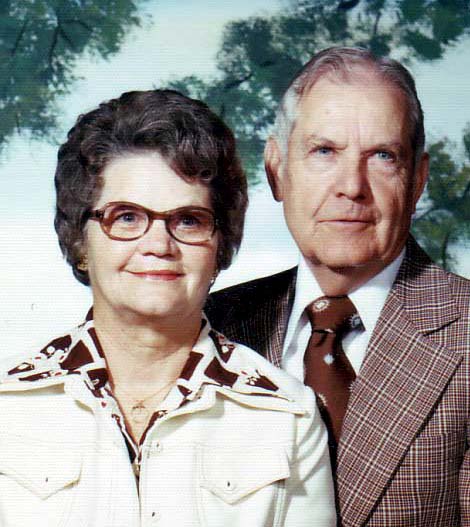
The times, they were a’changin’. I had worked before – for a brief time in my mother’s library, and in the cafeteria. Now I needed to make some serious money. Mom’s secretary was Dell Weldon, wife of Pete who had the accident with me on his tandem bicycle years before. Dell reported to me that Pete informed her, “I think it’s time we let the kids buy their own vitamins.” That sort of summed up the life-cycle changes for me. Here are Dell and Pete in later years with Helen Young.

I wrote a prayer: “I admit before You, Lord – You’ve made me precious to a lot of folks. One reason why I want to be precious to one person is so I can have him with me wherever I am. You’ve kept me moving so much! I have to keep loving and being loved by groups – and then I leave them. What is Your will here?”
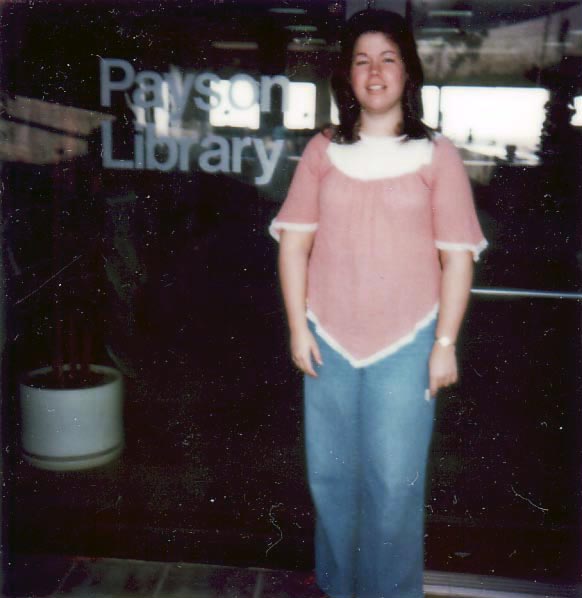
We return to the narrative from my journal, written in 1979-80 and reflecting back on divinity school days. “I went home for the summer, and proceeded to hibernate emotionally for the next three months. I lived with Momma and worked in the Payson Library as a pretend professional. What a joke. (The only real professional thing was the bucks, which all went directly to Vanderbilt the next fall.) […and the one ‘faculty meeting’ I attended, feeling like an imposter about to be discovered and thrown out.]
“I don’t remember my relationship to the girls that summer. Marilyn and Sara were living in an apartment in Pasadena and going to Fuller Seminary for a counseling degree. Caren Houser I remember only once from that summer. She and Kenny Waters and I went to church once together and afterward, while we were eating, I complained in my new Yalie tone of voice about how June Nichols [a Bible teacher from Church on the Way who had come to Belmont the year before to teach about women’s submission] just didn’t speak to the questions I was facing – not that she was wrong, just that she was not helpful.” (I wish I had written down some of the things that came out of my mouth that year! It would be so wonderful to rethink those thoughts from this perspective.) Here are Caren, Sara and Kenny Waters in the yard at the beach house.

“That was the summer of my salvation by Kenny Waters. He would call on Wednesday afternoons and ask if I wanted to go to Church on the Way with him. He not only saved me from the Malibu Church of Christ, but also from a negation of my womanhood. With Danny’s rejection and Mike’s emotional blockade, I was really vulnerable to more radical self-doubt than I’d already experience in the waiting years. We had some good talks. I enjoyed his future orientation, planning books and trips and projects. It felt so lively after Danny’s denial of future and Mike’s submission to the academic system. But despite the sharing, old Kenny was reserved and defensive of his emotions, and again I was frustrated, trying not to receive his reservation as rejection of me, but having a hard time with it…
“It had been a long summer of being mostly alone. I wasn’t yet ready to really be at home with myself enough to feel and think and grow with the alone time. Yet I was past my romantic period of fantasy and cleverness, music and books. Overall, the summer was pretty dull. I was numb, and sort of holding my breath. I wasn’t relating to anyone on a deep level, and except for Kenny, nothing new was happening. Here’s a meditation or prayer I wrote after one visit to Church on the Way, the First Foursquare Church of Van Nuys, California (as they always announce at the start of every teaching tape I’ve ever listened to from there.)

23. August 1976
Whenever the Lord leads me to touch someone else’s hand, He’s there with His hand on mine…
If He puts someone on my heart, I can take it because the Lord is there covering both of us while I’m caring for that one…
Whenever I’m led to minister to someone, while I’m holding them, the Lord is ministering at the same time to both of us, holding us…

Holy Lord God
Cover me
Impart to me gentleness
that in holding I do not grasp
that in covering I do not smother
Impart to me confidence in Your holding me
so that I may battle from a firm position of strength
that in speaking I may not shout
that in hearing I may not misunderstand
that in standing I may not struggle and thereby
lose ground You have claimed in me
nor ground on which You would establish the other
Minister to me Your peace
Your hope
Your faith
Your love
Circumcise my ears that I may hear Your voice
Circumcise my mouth that I may speak Your words
Circumcise my heart that I may feel and receive
others and their hearts as Your heart feels and
receives the pain and the joy of Your children.
Glory to Your holy and matchless
Your high and perfect
Your rich and gracefull
Name

The reader will kindly allow a brief departure from the 1980 journal entry for a report on what I actually did that summer. I spent eight hours a day doing boring, mostly cataloguing, work at Pepperdine’s Payson Library. I discovered at that early age that it literally hurt my hands to be in contact with paper and cardstock for that long a time. My muscles felt irritated by the repetitive motions, and I thought, “Uh-oh, not a good career choice, this library thing.” In my spare time, I forced myself to read the Tolkein trilogy, since it was on the Must Do list for my generation. I had loved The Hobbit, but it was hard getting through the final volume of the trilogy.

I set a goal for myself that summer. I had never achieved a real tan in the fifteen years I’d lived in California, and I had often felt like a misfit amidst all the gorgeous golden brown skin on display around me. I would burn, turn lobsterish, then I would peel, then I would be white again. I determined that this summer I would give it my best effort. I sat outside during my lunch hour. I lay out by the pool at my mom’s condo. I went to the beach. I finally turned a very light golden brown. At the end of the summer, I told myself, “You’ve given it your best shot and this is all the results you got. It’s just not worth it. Don’t ever worry about a tan again.” And I haven’t. Now, back to the Journal.
“Being withdrawn as I was, there was no way I could gear up enough to be with Danny and Doug, so I spent the whole summer not calling them. Probably expended a good deal of energy not doing that. I also, not so consciously, was not calling John Gottuso. Then, in God’s timing, I went to a strange Heidelberg Reunion party at Sandy Lemm’s house. I hadn’t been close to any of the people there – except, in that abrasive way, to Karen Davis, aka Kraze. So she was hiding out in the back bedroom, and I sought her out.
“Within moments, I was spilling my proverbial guts – how I introduced the topic I can’t imagine – but there I was telling her about Danny and then Patrick, and Larry at Church on the Way, and my responses to all that. [Note to reader: Larry was a man I happened to sit by at church one night, and when it came time to form the traditional small prayer circle, I turned to him and asked him, ‘Are you struggling with homosexuality?’ He wept and agreed he was, and we prayed together.]
“She couldn’t believe it. She said in her incredible way, ‘I swore to myself, there’s one thing I’m not gonna talk about – especially not to Moore.’ And that was it. Oddly enough, she’d had a parallel experience. About a year previously, within a week or two, four of her male friends had confessed their gayness to her, and it had flipped her directly into that head of, ‘What’s wrong with me??!’ So we, obviously, had a lot to talk about. (I’ve speculated about who the guys were – she never told me – I’m pretty sure I know who one of them was, because four months later I met him at the LAX airport bar to confer about it.)
“The rest of that night’s conversation runs into the other nights, so I can’t distinguish what was said first. But what a connection. Another stage of awakening – I felt vital and alive and dangerous and interested again and here was someone to talk to. We decided we needed to meet again and continue the process. I think for her too it was an important experience, to be able to reflect all those feelings and agonizing thoughts on someone who was equally moved by them. So we met at the Magic Pan in Hollywood and talked some more. I remember it was hard to confess my past without implicating others.
“The most wonderful moment of connection for me was when she was describing some lesbian friends at MCC
[i] and I ran her the rap about that kind of confrontation: ‘How can you deny one whole half of the human race your affection and love? How can you choose to give yourself only to men? How can you deny your feelings? Make up your mind! If you’re gay, why not act on it? You know heterosexuality is fucked up. There’s genuine concern and affection here for you, and great sex…” etc., etc.
“She screeched delightedly, ‘You’ve heard it too!’ and I said, ‘No, I just figured that’s what they’d say.’ It amazed me to hear all that coming out of my mouth. I hadn’t consciously thought it out, much less heard it from anyone, but I’d read enough MS. magazine to get the jargon down. [And Bev Nitschke and I had talked about the pressures certain people at Yale were putting on her to ‘admit she was gay.’ I was doing what I always had done, explaining that gayness is not a fate to which one must resign oneself. That God wouldn’t tell people not to do it if they had no choice in the matter.] In fact, that was the real amazement of talking to Karen – actually talking it out. I hadn’t talked to anyone, verbalized it, felt it, shared it with anyone ever before.
“That night we were walking to our respective cars and she said, almost as an aside, ‘You know, my two roommates are going to this incredible counselor; they think I should go talk to him.’ Out of a dark corner of my mind, I pulled out the question, ‘Is his name possibly John Gottuso?’ We both fell out. ‘WHAT?!’ ‘The same guy.’ ‘Incredible.’ ‘How did you guess?’
“Well, it was too obvious a set-up to ignore. We had to go see Gottuso together. It seems he specialized in counseling lesbians and gays. Lord Almighty. I called him and said, ‘Hi, remember me? I’ve got this friend, and we want to come see you.’ I was oblivious to the fact that he would doubtless assume that we were lovers. He must have been somewhat confused by our denial of that – trying to figure out why we were both so defensive if we weren’t involved, or why we would come to see him together if we weren’t. We showed up at his house in Arcadia and finally started talking at ten p.m. He and his wife had a new baby, and I felt jealous in the old Matt way, watching his wife and thinking, ‘What has she got that he married her? That she’s got him?’
“My memories of that talk are real specific – three of my most intense hours. The first confrontive technique he used was the same as before – the sexual shock test of sitting there with bare chest, just out of the shower with a terrycloth wrap on, which might or might not conceal nakedness down below. Where I only nervously looked occasionally, Karen was crassly verbal. So Gottuso said, ‘Do you want a look? If you do, I’ll give you one – don’t try to steal it.’ He said to Karen, ‘I did this on purpose to see what you two would do with it.’ It was the old, ‘Men’s bodies aren’t mysterious and scary, and the penis is not the focus of my maleness. I am not my penis.’ (I had said something about ‘seeing you’ and that had brought up the issue of ‘who you are’ – ‘You are not your genitals.’ Okay, but really. It was an in-your-face assault on my modesty.)
“He asked us to describe ourselves, and demanded that the healthy person is not defined by her roles. That left me up in the air – roles are all I’d ever thought in terms of. Left me feeling really unfinished on that one.
“The Moment for me was when he was talking to Kare about something and he said, ‘Look, Moore knows I accept her completely.’ I DID NOT KNOW THAT. But when he said it, it touched a deep hurt in my heart, and I began to want to believe that and take courage and comfort from it. The experience that most stands out from that night was the feeling of being confronted by someone so violently. Whenever Gottuso turned to Karen and questioned her, I could think clearly. I could hear him, and I could see her confused and flustered, unable to be straight with him. She could not focus and say what she was feeling, without defense. But the minute he turned to me, it went all foggy for me and I couldn’t cope any better than she had.
“I didn’t understand it until I realized it was an incredibly complex series of defenses that sent up that smokescreen. And there was more vulnerability rather than less for the person under fire – because it was so obvious that one was hiding and defending rather than being okay and present. That was my first taste of my own defensiveness and the dissatisfied, frustrating, intolerable sense of not being able to get out from behind that wall and make contact.
“I got a great behavioral revelation from Gottuso. Never before had I heard myself constantly saying, ‘My mother would say…’ I did it constantly until I met him. Noticing it helped me quit. I was taking her with me everywhere.
“I had always feared psychology people, and yet been ferociously attracted to them, because I felt they could see me, they could get behind my cloud and know how I really was inside. And I was afraid, but desperately wanted that too. To be known. Yet, before, I hadn’t trusted that someone could see me – they’d only be seeing a classic case of this or that neurosis.
My parents had always said disparaging things about the psychology people at Pepperdine, and indeed they were a squirrelly bunch. In my freshman year at Pepperdine, I had take an Introduction to Psychology class and found myself feeling resistant to some of it. I chiefly recall the last day of class, when the teacher asked us to line up in order of how open and vulnerable we had been in class. I was infuriated by how unfair that exercise was. Somebody was going to have to be at the end of the line, whether they deserved it or not, taking the least respectable position in terms of the desired qualities of openness and vulnerability. So I marched directly to that place as a silent protest against the injustice. I also knew that I really belonged toward the back of the line, and that made me mad too. I hated being classified and evaluated.
“Well, Gottuso cared about me. So I wanted him to figure me out, and I wanted him to be right. Oh, how I wanted to stay in that house indefinitely. It felt like finally being in good hands. Here was someone who could let me be screwed up, and out in the open, and maybe HELP me too. It was really painful to leave there that night. I felt a little desperate to be heading for Nashville the next week and maybe re-entering my numbness. I knew I was waking up to something, and if I didn’t have help, I was afraid I’d go back to sleep.
“Kare and I talked some more on the way home, coming down somewhat from the intensity, but not enough not to stay awake the rest of the night. We ever dared to talk in the same bed, but it was too dangerous to hold each other, both of us fearing the affection we wanted to have and give as being gay emotion. It was hard to think about not growing together, now that a level of compassion and companionship had been established.
“Incredibly odd experience the next night. It was my last week at home, so Momma had a right to be mystified about my behavior, spending two evenings of it with this strange woman I had never mentioned to her before. But the gutsiness of that lady! I was in bed and she came in and with very little preface simply asked, ‘Are you a lesbian?’ Geez. What a moment. I said, ‘No, Momma, I can assure you that I’m not a lesbian.’ Okay. How I wanted to tell her about Danny, but that was not going to happen for another year.
“How exactly did Gottuso prepare the way for what was to come?…I began to distance myself from [Momma] when I heard myself quoting her, and slowly quit doing that. The focus with Gottuso, though, was my father relationship – yet it was an unfulfilling direction, because everything I was in touch with while talking to him (which wasn’t much) pointed to the classic Electra complex, and neither one of us was satisfied that sex with my father had ever really meant anything to me. It was more a discomfort, an inability, in relating to myself as a woman (like Momma) and therefore an unhealthy identification with male roles, wanting to be like Daddy, to be accepted by him and by other men, but not as a woman. So there was lots of role confusion coupled with a real fear/attraction to the totally mysterious, frightening world of sexuality. That sent me along the paths of sexual roles, and insight into my selfhood – but no, before I could go there, I needed a real close first-time look at how I was, what I sounded like, what my needs and games and relationships were really like. The proverbial Awakening.


My journal account continues, “Then there were two lonely, fearful, anticipating weeks in Nashville, getting settled at Hospital Hospitality House and into classes at Vanderbilt, and then I met Marty…His friendship served me in so many ways…Here was someone who liked me, liked who I was on all levels, who could befriend me in the new places I hadn’t dared to look before. He was that gentle mirror without which I couldn’t begin to see my outward behavioral bondages[ii]. He was a companion who held my hand as I walked down those dark halls in my past. He was the encourager, who said, ‘You can write. You can think. You can create. You can feel. You can hurt. You can grow. You can dare, and fail, and dare again. It’s okay. You’re going to be okay.’
“He encouraged me in my attempt to relate to my own painful identity as a misfit in standard American roles. He encouraged me not to run from my pain, but to use the pain, be with the pain, feel it and move past it. To be in a hurting place and be willing to stay there until somehow God could work His changes. Not to deny reality. Not to cover and hide and pretend. Gosh. To feel was an amazing new thing. I never knew I didn’t allow myself to feel. The whole rationalistic, legalistic view that feelings were bad, wrong, dangerous – because we believed they couldn’t be changed, dealt with, we had denied them, yet continually suffered because our actions were based on them, and not on rational truth, rightness, like we tried to claim. Marty referred to me as a woman, and every time I heard the word it shocked me into an awareness that I didn’t see myself that way.”


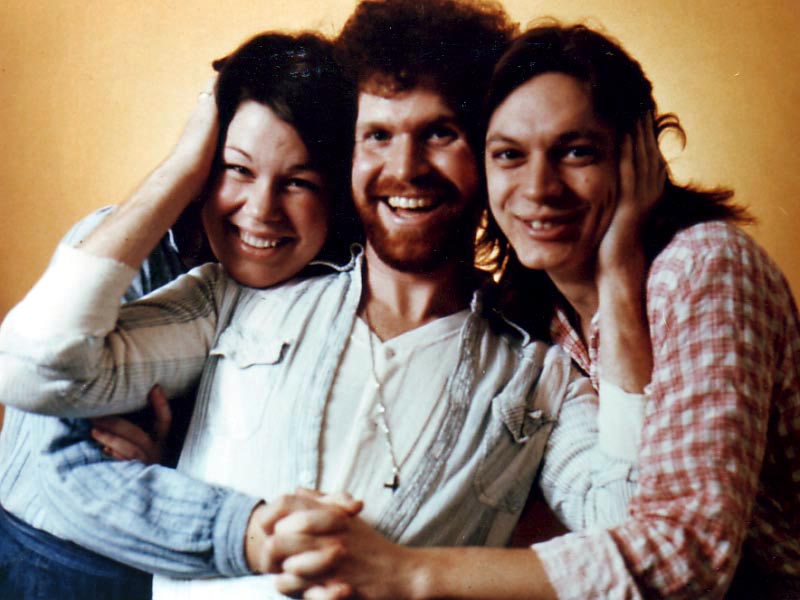
A note of explanation: Marty had come to Nashville to be a solo artist, but instead Word Records’ Myrrh label offered us a deal as a group – Marty (above middle), Gary Pigg (above right) and me. We became one of the first contemporary Christian rock bands, Fireworks, and then with an album under our belts, it was time to sign with a booking agent. I decided it was God’s will that I leave the group, one of the hardest decisions I’ve ever made. But it would have been even more painful if I had stayed in the group. Marty’s and my friendship shifted dramatically when Vickie [his high school girlfriend] moved to Nashville. I hadn’t processed anything of Daddy’s abandoning in his death, and the confusion and death I experienced when Marty turned away from our friendship was painful on that kind of level. So a door to my heart slammed shut again, and stayed shut for almost two more years – until the conviction of the Holy Spirit in regard to Jerry Gaston, the September that A Severe Mercy[iii] opened it again.
“Seems like it would be good to reiterate what came up about Daddy when I was with Gottuso. I had realized years before that I ‘needed a strong man’ because I would dominate a weak-willed, insecure or indecisive, accommodating personality. But then the Lord revealed that’s a desire to be dominated, to be irresponsible, and no more truly submissive than if I were controlling. Still, I knew I needed headship
[iv], and the way Gottuso seemed to offer himself was permissive and scary.
“The following spring, I was sitting in Introduction to Counseling [at Vanderbilt Divinity School] and a revelation came regarding my fear of intimacy with men. Not only had I received Momma’s already well-developed defense structure, but I had constructed my own to deal with the imbalance at home. The professor was telling a story about his own family, and a light went on for me.
“He said, ‘You know, the other day my little girl came to me and said, “Daddy, will you marry me?” and I gently told her, “No, honey, I love Mommy and she has me – I’m already taken.”’ He said that every child comes to the point of identifying the same-sex parent as a rival for the love of the other parent, and needs to be firmly assured that the love of that parent is theirs, but not like that – they’ll have to find their own mate.
“As he told his story, I realized that I had never felt that gentle but strong assurance as to what our proper relationships were at home. These were the messages I received from Daddy: ‘You are a treasure, you are extremely intelligent and talented, to be admired, even worshiped. I tell everyone else how wonderful you are, but I can’t tell you. (Why not?) Your mother is our mutual enemy – I don’t understand her, I fear her emotions, especially her anger. I don’t know how to deal with her much of the time. I resent her for hurting you.
“‘I’m angry that you can’t achieve a truce with her, but – I can understand why. I like to be alone with you, but don’t know what to say to you when we are alone together. You are not attractive physically, so you must become remarkably intelligent and informed to compensate. And you are that, so emphasize it in your goals. You will achieve much – I won’t be able to comprehend your thoughts or apprehend your world, but I will honor you as having surpassed me in the fields I respect.’
“Mostly the message was, ‘I don’t have a healthy relationship with your mother – I wish I could be affectionate with you – but since it’s taboo, we’ll have an agreement that you won’t grow up as a woman at all, and that way neither of us will have to deal with the dark sexual issues.’ And then, when I was newly discovering womanhood, groping for identity and definition and acceptance on a person level, and losing in the sexual contest, he left me. Strange that the night of his death I went to a wedding and realized he wouldn’t be there to walk me down the aisle, to give me away. I felt on some deep level then a hidden message, ‘I don’t want to give you away. I don’t want you to relate healthily as a woman to another man. So I’ll leave and you’ll always feel unreleased.’
“Lord! How amazing. I don’t think I’ve ever realized that one before. Only You can provide the release I need. I hardly need to mention that this very lack of permission (to seek a healthy relationship with another man) seems to be the very thing that turned me to unavailable men – they could be trusted to tell me ‘No!’ when I tried to relate intimately to them – and that’s what I was seeking from Daddy, a solid ‘No.’ Then, in his death, he seemed to be saying, ‘That’s right, have relationships with men like me – afraid of intimacy, not able to talk to you as an equal, but appreciative of your talents and tastes, while angered (passively) at the strength of your personality.’ Unavailable men. Of course.” And that's as much as I understood as I looked back a few years, journaling at the age of 27.


[i] Metropolitan Community Church, a church established exclusively for the benefit of homosexual and lesbian people.
[ii] “Bondage” was a word used in Christian Charismatic circles to indicate spiritual oppression, habits of thought that led to sin, personality or character deficits that evidenced a spiritual problem. It had no connection to the sexual connotation that is common outside Christian circles.
[iii] A memoir by Sheldon Vanauken, A Severe Mercy included letters from C.S. Lewis and described a romance so intimate, so vulnerable, that I was confronted by my many defenses. Reading it, I realized I had been keeping my friend Jerry Gaston at such a distance that it was actually abusive to him. When I confessed, and promised to change, I discovered that Jerry was more comfortable with the relationship as it had been, and did not want to be closer.
[iv] “Headship” = a reference to the concept that the husband is the head of the wife as Christ is head of the Church, this idea has been misinterpreted as license for men to abuse and dominate their wives. See Ephesians 5:21-33.

Thursday, June 29, 2006


In the spring of 1975, I discovered a new kind of relationship to single men. It was partly the fault of those guys who lived at the house on Oriole Place. I’ll never forget the night Jack Milam danced with me in that living room. It was just a short dance, I have no idea what the music was, but it was the first (and last) time that a truly gifted dancer had led me, and I found out I could respond and feel incredibly graceful and together with him. Mind you, dancing in my high school and college days was either far apart, with psychedelic gyrations, or if it was a slow dance, the feet were hardly moving and the emphasis was on pressing as much flesh as possible. I had never met someone before who could really partner me in a dance. This was a revelation to me as a way of experiencing and expressing the differences in masculinity and femininity.

You’ll remember those two guys I rode back from Abilene with, Clark Collins and Fred Walker. Well, Fred and I had some sort of instant connection. I felt comfortable talking to him, I felt his affection for me, and I wanted more of whatever this “brothers and sisters in the Lord” thing was. There was an intimacy and vulnerability and openness and willingness I had never met before in a male person of my own age. I wrote about it. This friendship with him made me feel for the first time how very untrusting and untrustworthy my heart had been up to this point, and made me want to change, and be changed.

Father, these are some of the gifts You have given me in these days:
“Do you want to come get coffee with us?”
“Praise Jesus!” (in answer to my “I’ve gotten spoiled to seeing you.”)
“We need to do some sharing, heart to heart.”
“Father, we just want to do Your will.”
“Sister, I’m trying to walk in the Spirit.”
A warm Spirit-filled prayer of a hug…
An extended arm that says, like Jesus, “Come…”
A grip on my shoulder…
Arms that encircle me and lift me in the spirit towards God…
Someone in whom I see Jesus working through a yielded spirit…
A man who prays with me and for me…
A gentle, reassuring touch that says God loves me.

And Father, what have I given You in return?
The groanings of a disappointed child
Attention paid to fleshly desires
Time stolen from relationship with You
The schemings of one who doesn’t trust her Father’s love
Fears and comparisons and spiteful thoughts

But I confess before you, God, that You are doing a work.
You are working in me trust, and patience,
a greater freedom in Your Spirit,
the conviction that Your mighty plan transcends
momentary human desire,
but the corresponding conviction that Your love for me
is mighty, and that my heritage is really beautiful,
the hope and the faith that You are in me to will
and to work Your good pleasure,
and the desire to be pure and wholly Yours.

I praise and bless Your name
I magnify Your glory, and confess that You are
exalted above all creation
I bless the name of Jesus
and I praise and bless God.
Make my life the life of Christ.
Make of me a blessing.
I praise You.

Take our futures and make them work
completely according to Your holy will.

Praise You for the faith that You can do it.
Praise You for the hope that You will.
Praise You for the assurance that You are at work.
Thank You, Lord.


I wrote my mother sometime that spring. I had never lived in a real barren winter or lush springtime before, and it astounded me. “Dear Momma, I’d love to talk to you but I’m just about broke and last month’s phone bill was a tad embarrassing. So I’m being conservative, and besides you can keep a letter. This morning I felt like I had to write you just to tell about the beauty. I drive down Fairfax between West End and 21st and it’s as though the street were planted to be beautiful in spring. This is the first week the leaves are really bursting out, little crinkled pale green and yellow, and that looks fairytale-ish to me all be itself. Then there’s lots of redbud trees, and the cherry trees are mostly in bloom, and the daisies (“weeds” Daddy called them) and daffodils, etc. are all over. The sweetest blessing for me is that our yard is full of wild violets! like the Pink House used to have on 29th. Not so lush, but they’re all over. Today it was warm and humid and green smelling (70º) and the sky was tremendous, lots of clouds. So the day itself was a blessing. Of course, there’s a tornado watch tonight but I’m not too worried.

“The activities of the day turned out to be even more exciting. I got to go to ladies’ Bible class this morning, about six young mothers and six old ladies (70s) and Martha Finto and Martha Allen (one of Naomi’s roommates) all shared a scripture and talked a little. The theme of the morning turned out to be anxiety, and it was such a thrill to hear those sweet women who’ve walked with the Lord seventy years tell about His faithfulness. One lady read the 23rd Psalm and another commented, “Can’t be beat.” I loved it.

“This afternoon was really exciting too (it gets better and better, just like life in the Lord). If you’ve ever heard of William Stringfellow, I read a book by him in about 10th grade about his experience being a Christian lawyer in Harlem and it really moved me. He was invited to speak to a class at Vanderbilt called “Death and Dying” and I got to go hear him. He nearly died two years ago of a rare disease and he talked about the same thing that he had said in the book ten years ago – that the power of the resurrection is available now. In other words than these he said that if you’ve already died you’re free to live, free from the fear of death. Death is the moral force against God and it’s what most ‘sins’ stem from – materialism, hunger for power, violence come from fear of death and are forms of idolatry of death. Anyhow, in essence he preached the gospel to these Vanderbilt students, who didn’t seem to get it. But we did and it was so neat to hear him speak in such faith and commitment and yet in such scholarly, sharp, intelligent terms. Whew. You might really appreciate the book My People is the Enemy.

“Then since I wanted to go to his speech I missed Vultee and got to go to Belmont. I’ve only missed about three Wednesday nights all year so I figured I deserved a break (small joke – you understand). Anyway, the service was a real blessing, as always, and afterwards I got to talk to Bob Mason and several other fine people. Then as I was talking to Fred Walker (my dear crush, the first one I’ve ever tried to walk completely in the Lord’s will) he asked me to go with a bunch of them to eat. I was delighted, since two weeks ago I got to be with him so much, in that way twice (it was three weeks ago) and then the past two weeks I was really praying that the Lord’s will be done and I hardly saw him at all. Anyhow, as he dropped me off, he said we should get together sometimes and ‘do a little sharing heart to heart,’ and got my phone number. Now I’m trying to stay completely calm and just ask the Lord to work and thank Him for each little blessing. But it’s such a major encouragement to be with fine strong growing men who belong to Jesus and seek God’s will.

“The Lord never did a better thing than bringing me here. I keep getting to know and be with more people every few weeks, as though I were settling in for a good while. Wouldn’t that be a funny turn of events. The fellowship here is just constantly available and always a great strength and blessing. If I thought I could keep you at Belmont I’d almost wish you would come live here. Never to Nashville for itself, just for what God’s doing. Bob Mason and I prayed for you tonight.

“There’s been a crazy little thing happening this week which I should tell you about on the condition that you only pray about it and not worry. I’m concerned enough for both of us. I’ll tell you first that Don Finto and Bob Mason both know all the people involved and are somewhat excited about it and are praying. I’ll tell you names even though they won’t mean anything to you. Two fellows, Don Woerner and Jack Groschmal, and I got together at a well-known man’s home recording studio this Saturday and cut two demo tapes which will likely be sold soon. Demos are like sample recordings of songs that people take around to music and publishing companies to promote songs, etc.; but one of the songs may be sold as a final version and we’ll get the profits. Here’s the basic story – it all fell together last week without any planning. There’s a guy at Belmont who does the recording of sermons, etc., who’s a pretty well-known song writer, Gary Paxton (Tell Chip he wrote “Alley-Oop”) who talked to Don about getting a group up to do demos for him regularly, and if the group developed and was good he’d be glad to help it in whatever way.

“Well – all this has rather bowled me over, to the extent that I’ve been nervous about it, sort of felt like it was all so quick that it might go on developing at breakneck speed and be like a whirlpool and suck me in against my will or deceive me somehow. But the Lord knows (because Don Finto and Bob Mason and others and I are telling him) that I want His will. That if it’s supposed to go, it’ll be amazingly obvious, and if not it’ll just be defeated. The real point in its’ favor it that everyone involved is a Christian and wants to praise the Lord only, and the songs are all gonna be about Him. So you can pray. It may fizzle out.

“Bob Mason was funny tonight – he got all excited as I was telling him and said in his prayer that if this meant I should stay in Nashville and not go to Yale he was so thankful because that’s what he wants. (On the other hand it could be the way I could finance the year and not have to kill myself working. God’s will be done.) I told Bob I was trying to have a crush in the Spirit and he should pray God would find me someone (everybody’s so fired up about Christian marriages being made around here) and he said, ‘Some fellow’s in for a real blessing.’ So sweet…

“I miss old Sharyn and Chip a lot. Give them both hugs, and Sara and Caren, and Mrs. and Dr. Young, etc. etc. I love you so much, sweet Momma. Bless your heart. Father God, bless us both with your peace and strength— Love you, Gwen”

Well…it wasn’t the right time or the right people yet, but it turned out that this little flirtation with the music industry was a portent of things to come which I could hardly being to imagine.

I’ll introduce a few more players to the cast of Tennessee characters that came from my parents’ life. Momma and Daddy’s first home together had been in Tullahoma, Tennessee. Daddy had the nerve to be a conscientious objector during World War II (as were both his brothers), so his service time was spent at Camp Forrest near Tullahoma, where German prisoners of war were eventually brought. He worked at least part of the time as a supply sergeant, and managed the officers’ club. Someone said he had a silk smoking jacket (he didn’t smoke) and looked quite the elegant gent for an enlisted man. The story goes that there was a $500 governmental limit on how much one could spend on new construction, and they cobbled together a one-room home for that price in which many house parties were enjoyed, with folks spending the night on the fold out bed and in chairs.

In Tullahoma, they met a couple at church who would prove to be dear friends for the rest of their lives. Jack and Frances Thomas were older than my folks by a few years, and well established in the community. He ended up the high school principal, and Frances would walk across the street to substitute teach “with a Bible under one arm and Uncle Remus under the other,” as she wrote in a letter to me. Frances was the one who taught me about B’rer Rabbit and the Brier Patch, a classic tale of brain over brawn.

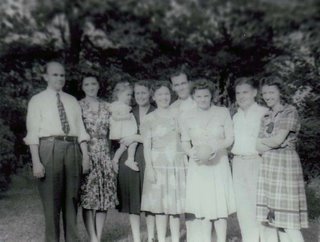
Here’s a party at the Whitesells before most of the children were born, with Norvel and Helen Young, Suzanne Moore in Grandmommie Whitesell’s arms, Dot and J.C. (my folks), Frances and Jack Thomas and Marian Whitesell Moore. Her husband Paul (my dad’s brother) was probably taking the picture, as was usual for him.

I didn’t know this until a few years ago, and was properly horrified when I heard the story. Apparently one day after church Frances had invited a large gathering to their yard for a Sunday dinner picnic, and my dad walked up to her and said, “You know, you’ll be ruining a perfectly wonderful meal if you don’t make some hot bread to go with this.” So she dutifully returned to the kitchen and whipped up a batch of hot buttermilk biscuits to satisfy him. I couldn’t believe it.

But the story fit with my mom’s tale that when they married, he said she needed to learn how to make perfect cornbread. She tried recipe after recipe until she hit upon the one that pleased him most, and indeed I’ve always thought her cornbread was the best I’ve ever had. Of course, most people think the way their mother made cornbread or biscuits is the way it should be done. I’ve included the recipe in the Appendix. I titled it “Grandmommie’s Cornbread” because that’s what Momma called it when she gave it to me. Could it be that after trying numerous recipes, Daddy settled on his mother-in-law’s cornbread as the winner? It seems so.
Frances was a great hostess. Even after she stopped cooking, she would take her own placemats and napkins to the restaurant where she and Jack would feed us. And both of them always made me feel as if I were part of the party, instead of an appendage to be relegated to the den. The day after Momma’s funeral, Chip and I went to visit them, and Frances remarked, “Now this is true friendship. We couldn’t come to you, so you came to us."


More dear friends from the early days remained part of our family circle. Harold and Helen Buchi were also a couple a bit older than my folks who show up in the pictures of parties and gatherings from the Nashville days before children, and continued being dear to us till their deaths. You’ll note the photo of their daughter, Barbara, who was my age, standing with me in the Youngs’ driveway the summer we moved to California, 1958. They also had another daughter and a son closer to Chip’s age. He established Buchi Plumbing, and sadly was killed in a car accident not long after my dad’s death, so Helen and my mom began to take trips together from time to time. His accidental death occurred tragically just after they had completed their “dream house” which held many elements that also became my idea of a dream house.

It was on a short block called Cantrell, and featured a round three story stone tower as part of the front door, with a spiral staircase to the basement. Dividing two separate guest bathrooms was a rough stone wall with natural ledges where Helen put tiny objects like a gnome or fairy. There was a landing on the second floor that overlooked the library, with a free-standing stained glass window in a frame, and in that library there was a great find, one of the study tables from a Peabody building that was being discarded.

There were Persian rugs and a grand piano in the living room, and a real Japanese rock garden outside that room. A wonderful brick fireplace in the family room at the back of the house made a cozy corner where we would sit and chat with Helen in easy chairs. She was such a delightful, positive, lively person. She had a collection of “ABC” books which I added to every Christmas, and she built my collection of Arthur Rackham fairytale illustrations with a Christmas gift each year.

A Day in the Country

Naomi had found a young man I would have described as “stone country”. He was named Clay Taylor and the three of us became friends. His parents, Mr. and Mrs. Tillman Taylor, lived in Clarksville and one day we went to visit them. On their door was a calling card on which was printed “Mr. and Mrs. Tillman Taylor” and in pencil, “Come in. Back soon.” Clay said I could keep that, and it’s taped in one of my journals still. The day was so rich that of course I had to take notes. It turned out that the Taylors had known Dieter Alten, one of my favorite German preachers. When the American missionaries send him to school at Lipscomb, he would preach at the Taylors’ congregation. Mr. Taylor said, “Dieter Alten had compassion for a little orphaned opossum, and he fixed up an incubator and tried to feed it milk with a nipple.” Here are more quotes:
(Apparently, when he was a little boy, Clay used to go outside and preach sermons to his pets or the side of the barn.)
“I remember the subject of one sermon – it was shorts. Wearing shorts.”
“Were you for or against it?”
“Against.”
“See all the girls he knew was his sister, and all she knew was what her parents said, and so that was the way they saw things.”
I gleaned a series of classic Southernisms for my collection:
That’s a whole different set of dogs.
He was choppin’ cotton trying to get something done.
We searched for dear life…
Cute as a speckled puppy under a red wagon…
Slow as sorghum in January…
He probably preached to the barn what he and the fireplace had discussed that morning.
If it takes a woodchuck with a rubber bill nine months and thirteen days to pick a hole through a cypress log big enough to make a bundle of shingles selling for 65¢, how long would it take a grasshopper with a cork leg to kick the juice out of a dill pickle big enough to make a meal for a bull snake and a rhinoceros?

Grandmommie

Springtime was full of Nashville beauty, with the redbuds and dogwoods and fruit trees all in bloom. Grandmommie decided it was time for her to sell the Primrose house and move to the nursing home on Wedgewood Avenue, called Lakeshore. Before she moved, I asked her to take me on a tour of her backyard garden for the last time, so I could write down everything she was growing at that moment. She had sweet peas, candy tuft, yarrow, larkspur, ragged robin, Queen Anne’s Lace, and something she pronounced “awthrawatera”.

I’m so grateful for that year spent “getting to know the relatives better” because it was mostly about Grandmommie, who was not going to be with us all that much longer. If V.M. hadn’t asked me to “carry” her over to his house every Wednesday night, I wouldn’t have been able to collect these precious quotes from her and save them in my journal:

“My dad went to college, you know; he said it was a waste of time, he didn’t encourage his children to go to college. Anyway, he had numerous volumes of Thackaway and Miltons and do you know, I read them, and they were bastards from start to finish!”
“But I thought Milton was a Christian…” I offered.
“Well, who was another well-known English writer?”
“Maybe Wordsworth?” I guessed.
“That sounds terribly familiar. But I remember that Thackaway. Why, the terrible lives they led, why I just couldn’t imagine. I was 14 or 16, a young girl when I read them. Just bastards from start to finish.”


~ o ~
“I thought it was such a pretty name – Dortherea –
but they wouldn’t call her that. When she started to school it was ‘Dot’.”
“Well, what’s on her birth certificate?”
“Oh, I don’t know.”
~ o ~
“Yes, your great-granddaddy was a ‘jelly bean,’ a real sporty young man. Dad Long owned a liquor store – it wasn’t so bad in those days, people didn’t get drunk so much – and when he went to courting my mother, she said, ‘I won’t marry a man who owns a liquor store,’ and he said, ‘Tonight’s the last time those doors will close.’ If he said something, he’d do it, so he went out and sold that store and bought a grocery store, and they went to live in the hotel.”
~ o ~
Grandmommie told me that her mother used to put her nine children out of the house in the morning after breakfast, and tell them they were not allowed to come back in until dinner time. If they got hungry, they were welcome to eat sugar cookies from a barrel she kept on the back porch. “I don’t like sugar cookies to this day,” she told me.
~ o ~
Mildred Thurman asked Grandmommie, “Which of your children are you partial to?” and she responded, “Whichever one needs me the most.”
~ o ~
Little Bob said, ‘Did you know I’m going to heaven? You’re going to miss me.’ It was almost more than I could take.” (Bob was V.M. and Lois’s first child, who died at the age of five.)
~ o ~
Momma told me to ask Grandmommie about the lady who got fatter and fatter until she wouldn’t go out of the house. “I don’t know why that strikes me so funny,” says Mom, cracking up one morning. The prisoner of her own girth turned out to be Eva Stinson, Uncle Gid’s daughter.
~ o ~
“Aint Addie, Virgil’s sister – you know, they’re all Cumberland Presbyterian – ”
No, indeed, I had never heard about any non-Church of Christ folks in the family tree. And I found out that a Methodist had snuck in there too!
~ o ~
“You’ve been a right industrious child…”
~ o ~
“That’s like my dad…he built a two-story house with half a saw and a hammer.”
~ o ~
“You know, Virgil proposed in a letter, and I answered him with that Ruth passage about ‘Entreat me not to leave thee…’ Dan Harless preached on Ruth the day Virgil died, and I told him, ‘Why, you like to killed me with that.’ He said, ‘I’m glad you told me.’”
~ o ~
“Now, be sure you know what you’re doing!! – and then you don’t.” (She laughed at herself, and the foibles of being human.) “A Ph.D., I guess it’s nice to have one, if you have your religion too. Now you make sure you have that.”
~ o ~
I asked her, “You know what you said to me one day?”
“There’s no tellin’,” she replied, with a smile.
~ o ~

Here’s a family photo taken on the back porch of the Whitesell house on Primrose, before Chip and I were born. Grandmommie lived there for fifty years, and then sold it to friends of mine. The kids in the picture are the two oldest, Suzanne and Ronny, our double cousins. The others from the left are: my dad, J.C. Moore, Jr.; Patsy and J.C. Moore, Sr.; V.M. Whitesell and his dad, Virgil; my mom, Dorothy (Dot), just above “Munner” (Nannie’s mother). Up top next to Virgil is his wife Bonnie Whitesell (Grandmommie) with her daughter-in-law Lois just below her; Marian (Mom’s and V.M.’s sister) holds Ronny; and Martha Nell and Winston Moore, probably newlyweds.

“Pappy Whitesell’s sister married ‘Font’ Harris. My great-great-grandmother, Martha Jane Harris, married a Stinson; her daughter Betty married a Long; and they had me, Bonnie. Uncle Gideon Stinson (a great-great uncle to you) was a big man in Lewisburg. Jim (James Gideon Long) was named after him. Cud’n Pokey (Pocahontas) Considine, Virgil’s cousin lived to be one hundred years old.
“Pap (J.L.) and Mammy (Betty) Long had nine children. I’ll tell you their names and who they married”
Vance and Ina Claxton had J.V. and Melissa (who married Trine Starnes).
Ross and Inda McNatt (these live in Huntsville, Alabama)
Raby and Mattie Lou McNatt (these live near Shelbyville)
Carl and Mary McNatt; Carl died, then Mary married O’Dell McKinney
Wilburn and Bess McKnight
Virgil and Bonnie Whitesell
Jim and Christine Long
Lester and Grace Mallard (Methodist!) Long
John Leon and Leona Long had Louise, a librarian who lives in Deckard.”

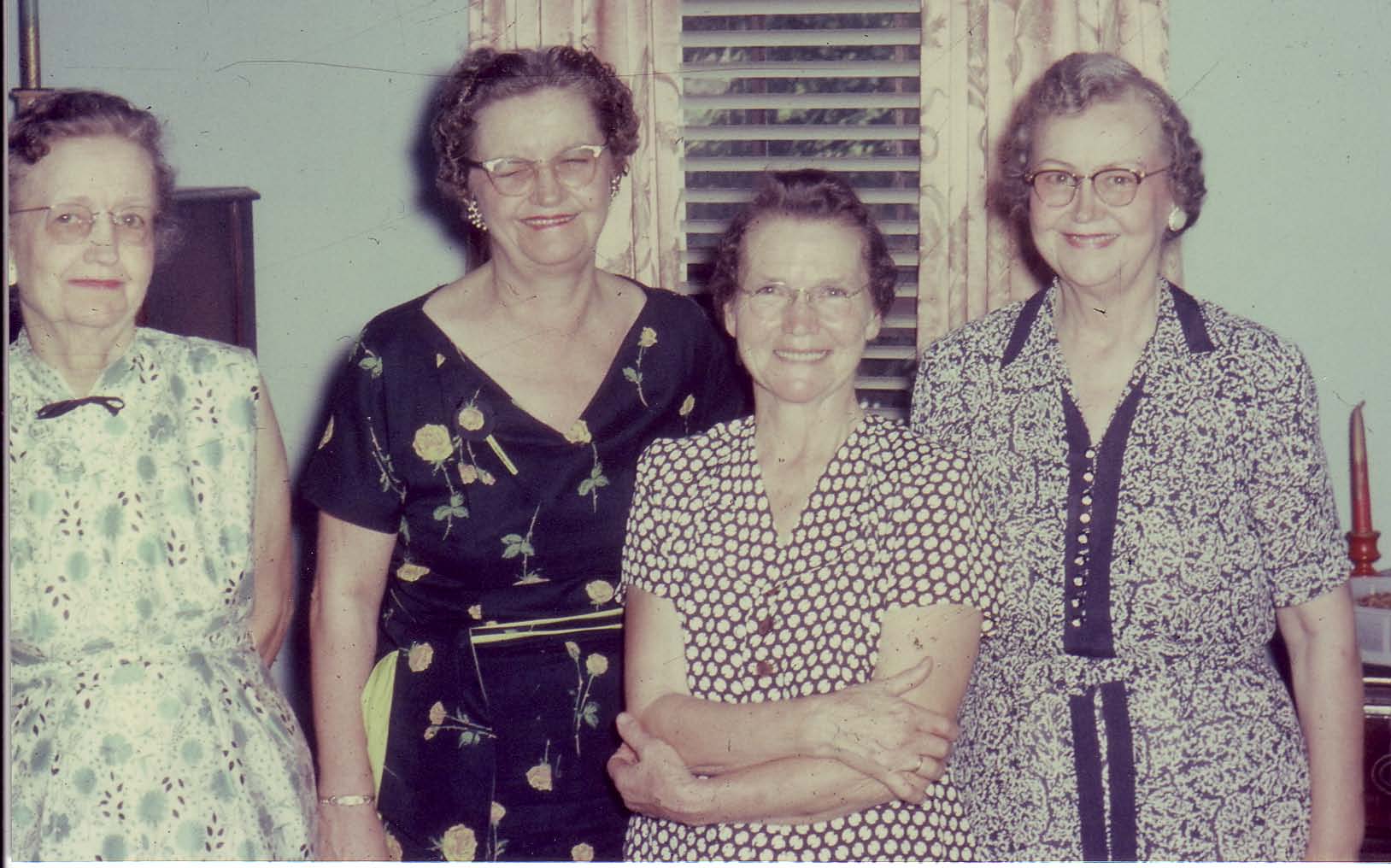
Here are, from left, Bess, Mary, Mattie Lou (pronounced “Aint Maddalu” all my life) and Bonnie, four out of the six Long sisters.

Tuesday, June 20, 2006

The fall in Nashville passed. I watched the squirrels play on the Peabody campus. I heard them play in the attic over my bedroom. They seemed to have a favorite game of rolling nuts across the floor – my ceiling – as if they were bowling. I watched the leaves turn so beautifully all over town, and the air turn crisp. I made good friends with a lady named Jessie in my library school classes, and I spent a lot of time at Naomi’s house, getting to know all these single people my age who went to Belmont to church.

Naomi got a job as a secretary in the Office of University Ministry at Vanderbilt, and she was amazed at the lack of faith she found there. But there was a lady whose husband taught in the Divinity School who was attracted to Naomi’s vibrant relationship with God. Shirley Forstman would often talk with Naomi, and finally decided that her daughter Val would do well to meet the likes of us. Val came over to the Lone Oak house for musical evenings, bringing her flute along with a troubled heart. It turned out she had gone to Oberlin to college and was pretty disturbed by the extreme demands for a high level of performance she felt she was under there. You could tell she was attracted to the difference in us, but it was so very different, she didn’t know how to appropriate it.

We all went to Belmont to church. Belmont was a very lively congregation. They had experienced a genuine revival in the past couple of years, and they were bursting at the seams, with people sitting in folding chairs in the aisles, sitting in the wide window sills, sitting on the stage behind the pulpit. I especially loved the “Amen Corner”, the pews that were set sideways facing the pulpit. The singing was full of power and deep devotion. Brown Bannister, one of the Texas guys I had met at Janice Hahn’s wedding to Gary Baucum, led worship sometimes and his heart was so tender it would make yours ache.

I started going to Bible studies and prayer meetings at night. At one point I was attending some meeting every night of the week but one. Someone commented, “You’re in graduate school? I didn’t know you were in school…when do you ever study?” because I rarely did. I was able to make it through the Master’s program as a “B” student without much work. I was majoring in Bible and minoring in Library Science.

And it wasn’t just Bible classes. There was a new thing happening in Christian music in Nashville as well as California. Groups were forming, original music was being written, recordings were happening. Those of us involved in Belmont Church and other fellowships as well were gathering every Saturday night to hear people play and sing. Some of them played so often that everybody learned the words to every song, and we all sang them together! Our favorite group was called Dogwood. It started out with six guys and their guitars, and finally was pared down to three. Then, when they got a record deal, one of the guys dropped out in revolt against the commercialism, and the songwriter’s wife joined them.

One might wonder why on earth a group would call themselves Dogwood. It could only happen in the South. The dogwood tree has white blossoms in the springtime, and there is a legend that the wood of the cross Jesus died on was the wood of the dogwood tree. The blossoms could represent the nails that were used in the crucifixion, because there are holes tinged with pink on the ends of the four petals.

In the music, the worship services, the Bible studies, the get-togethers at each others’ houses, there was a sense of togetherness, of adventure, of all being headed in the same direction on a journey. No matter how confused or inept we all might feel from time to time, we had each other to lean on. I was feeling myself absorb this new spirit of faith. There was an unquestioning humble acceptance of God’s will and God’s ways that I had never really witnessed before.

Having come from an academic environment where such humility would be considered mindless, this was the first time I had lived in the kind of atmosphere my heart had been longing for since I was a child. I used to read scriptures where Jesus would enter a town and heal somebody, and the “whole town rejoiced” or somewhere else, the “whole village praised God” and I would wonder what on earth would that be like? Now I had a taste of it, with these earnest and passionate believers.

At the same time, I was making more of a social break with my Church of Christ upbringing. (I had made the spiritual break long before.) My attending Belmont Church was not okay with my Nashville relatives. The minister, Don Finto, had been fired from teaching at Lipscomb because of his beliefs, and the congregation as a whole was suspect if not anathema. My uncle V.M., my mother’s brother, knew I was going to church at Belmont, and considered it his responsibility to “straighten me out.”

His first effort was to hook me into attending his congregation, Vultee, by asking me to pick up Grandmommie, bring her to his house, have dinner with all of them and then go to Wednesday night services together and deliver Grandmommie back home. It made sense because it was a way to get to know Grandmommie better by spending regular time with her. And it was great to have a nice meal at a table with a family. But the going to church part proved painful. I was in a class with Pam, my cousin and a couple of years younger than me, and I recall saying a few things that proved controversial.

V.M. then took the next step in my reformation. He invited me to have Bible studies with him. We had ten sessions, quite an investment of time and energy on both our parts, and I considered it an opportunity to really hear from “his side.” I wanted to ask him one main question, and I did. I said, “I realize that you and many other folks, when you read the Bible, have a certain filter you put over it. You believe certain passages apply to us today, and certain other passages only apply to people ‘back then,’ in the days of Jesus or the early church. So tell me, how do you determine which passages apply to us and which don’t? Is there some kind of rule or guideline you go by?” He really didn’t have a satisfying answer.

I felt it was an opportunity to share some stories he’d probably never heard the like of before, things that I knew of personally and things that others had told me. It was distressing to him to feel that he had done his best to persuade me of my errors, and hadn’t really budged me an inch. And I could sense he was stunned, shocked by a few of the tales of miraculous, supernatural interventions of God that I had witnessed or heard of. I talked about physical healing, speaking in tongues, prophecy. He had to be freaking out inside. He finally gave up. He called a truce, which resulted in his having nothing to say to me for the next several years.


0 ~ o ~ 0 ~ o ~ 0
I wrote to Mike every once in awhile. Here’s a letter from November 20, 1974.

Dear Mike,

I’m sitting in a graduate (still amazes me) carrel in the Vanderbilt library – not at all aesthetic, like UCLA if you ever went there to study. I feel more like writing you than thinking about the quarrel between Hemingway and Max Eastman. That’s one of the piddly little things I get to play with this week in Bibliography and Literary Research. Oh, for a paper to do on some intriguing religious topic! I’ve been attempting a more realistic attitude this week though. Probably in the middle of some semester in Divinity School I’d feel equally as itchy to be getting on with Real things. Even more realistic than that – I’d be equally embarrassed by my lack of knowledge and progress.

I’m wondering what this semester’s work has taught you, whether you did that Puritan paper, etc.

I also wonder why it is that my character gets worked on so much. Maybe I’m more aware of my faults than most people. The past few weeks we have had crash courses in the areas of: Giving Up, Patience, Criticism and Responsibility. Without giving away any particulars, I want to praise God that He’s helped me do and not hear only, a little lately. It feels like progress. In terms of being critical (of other people) I must be a real mess because I’ve had to have so many different lessons in it. It’s a blessing that I don’t understand – I don’t react that way to you at all. I must respect you too much or something.

Naomi passed on a possibly apocryphal tale that delighted me. Sam Jackson and your friend and mine J. Gaston, as you know, attended Wenatchee High School at approximately the same time, and it is said that they made one another’s acquaintance under a table.
“What?”
“Under a table. I think it was noisy in the cafeteria, or they were throwing food or something, so Sam went under a table and there was old Jerry.”
“Them Wenatchee people.”
“Yep, I don’t know if it’s true, but it’s funny, right?”

We’ve had sort of a workshop in New Testament conversion around here the past few weeks. A girl named Pam came to Nashville in August after having been thrown out of the house, and having to sell everything she owned. Didn’t know why she felt compelled to come here. She met one of the girls Naom lives with, started coming to Belmont and over to Naomi’s and asking all sorts of questions. (She’s from a Church of Christ missionary ultra-conservative family and hasn’t ever heard anything else.) Her life since she was 14 has been drugs and drunks and performing in rock groups and two years with an Edgar Cayce ~ demonic ~ seances type group. In the past two months she’s given all that up, and tried to seek the Lord. Because of that she’s had her car repossessed (her dad stopped the insurance payment), lost her job (her drinking buddies turned her in as a junkie), and at least three or four other traumatic experiences. She got herself baptized this morning at 2:00 am. If you feel like praying for her you should. It’s gonna be a real spiritual battle. Poorly told story but it’s meant a lot to me to be in on it. I’m always surprised at how surprised I am when what I talk about in theory really works.


I think I’ll be in Malibu at Christmas. Are you going to play the hermit again?

In our Hope,
Gwen
“Hats off!” cried the midget. “Hats off to the human condition!” — Merton
Lone Oak
After awhile of living at Duane and Carol Doidge’s, I started visiting at Naomi’s house more and more. It was fun being around four single women my age, it was fun getting to know the three who were new to me, and it was fun being out from under anyone’s control.

Elaine Davidson and Naomi had a tradition that Saturday was Fun Day. They would put on their overalls, tie on their bandanas, and head out the door looking for adventure. I loved joining them. Once we drove to Shelbyville where Elaine grew up and met her mom, and all of us went to the Jack Daniels Distillery, a local tourist attraction. Once I went horseback riding with Elaine and a few others, and another Saturday we took the wheat that Elaine’s daddy had grown to a mill for it to be ground.

This was my year to discover Aaron Copland’s Appalachian Spring. Naomi sat me down at their house one Saturday and played it for me, and I couldn’t believe all the feelings it inspired in me. It was like discovering the Impressionists all over again. It was refreshingly simple, modern yet classic, delightful, spare…sort of like the Shaker furniture that I envisioned when the Shaker theme Simple Gifts appeared in the Copland suite. I learned the words to Simple Gifts from Judy Collins, and thus began a fascination with the Shakers. I’ve visited their Pleasant Hill settlement in Kentucky twice, read several books and listened to their music. At one time, I shared their desire to create a Utopia on earth, and that impulse got me into a lot of trouble later in life.

Naomi and Elaine, Beckie and Martha lived in a little house on Lone Oak, and one block over on Oriole was a house with four single men who also went to Belmont. Clark Collins, Billy Mitchell, Fred Walker and Jack Milam were there at first. Later, the same house held four more precious men, three of whom who came to play huge roles in my life: Bob Farnsworth, Brown Bannister, Earl Carlisle, and Marty McCall. What a house! What a neighborhood.

One day that spring, I was riding a bike around the neighborhood when a blonde lady I had seen at church stepped out of the Oriole house and said, “Hey! Why don’t you stop awhile and visit?” It was Carol Ann Jackson Thomas, someone who would become one of my dearest friends. That spring afternoon in 1975 was the beginning of a very significant bond.

And there was another house full of boys that played a powerful role that first year in Nashville. A widower named Maddox had married a widow named Forrester, and together they created quite a remarkable household. Tim and Rob Maddox and Kim and Brad Forrester became step-brothers, and precious Vali Forrester was more outnumbered than ever as the only little girl. (No wonder she grew up to direct The Vagina Monologues at Vanderbilt.)

One night I was at the Lone Oak house and I got a hankering to go over to the Maddox/Forresters’ to see if anybody was home to talk to. As I got into the Camaro in the driveway, I clearly heard inside my heart, “Don’t go.” “But Lord,” I argued, “what could it possibly hurt? I’m not serious about any of them. I can’t mess up anything by visiting over there.” “Don’t go,” came even more insistently. I decided to pretend that it wasn’t really the Lord speaking, and I went.

Well, after I had driven around for ten or fifteen minutes unable to find their house, which I’d been to more than once, I gave up and turned back toward Lone Oak. I was at a corner on Caldwell where there used to be a stop sign. Not long after this evening, the city installed a traffic light. It was a blind hill, and after I had looked to the right, then the left, then the right again, I headed out, and SLAMMM! My car was hit by an oncoming car from the left, pushed into a ditch, and I found myself somehow getting out of the passenger door (with the engine still racing but the car stopped dead).

It was a teenager driving the family car. He had hit my door with the whole front end of this car which has just recently been repaired from another accident he had been in. It really was equally our faults…I hadn’t realized that the left side of the road was such a blind hill, since it was dark, and therefore my last glance had not been to the left. And I pulled out in front of him and took him so by surprise, he didn’t have much time to stop.

His parents came to pick him up and they graciously gave me a ride home to the Doidges’ house on Cherokee. I was starting to hurt, to shake from being in shock, so when I got in and called my mom, I started to cry. Duane reassured her that I was okay, and I went to bed. I lay there in the dark, feeling very remorseful, realizing that the Lord had warned me not to go, and the accident would never have happened if I had been obedient. I started apologizing to Him, begging His forgiveness, and I heard, as clearly as before, Him speak to my heart, “I love you. I love you.”

I cried all the more. I really expected a stern, disciplinarian, angry father, and what I got was His mercy and acceptance. It was the first time I had really known all the way through that God loved me, even at this worst part of me, my lifelong struggle with my will and disobedience. All these years later, I still have broken blood vessels in both my legs that remind me of this lesson in love. He saved my life that night.
Christmas with Danny
Christmas approached and I planned to go home to Mom’s house for awhile. Of course I would see Danny. We had written a little bit, but not enough to give me a sense of what to expect when I saw him again. Certainly no assurance that he knew what he wanted. And my time with Mike Johnston had not strengthened my desire for Danny’s much less verbal, less intellectually engaging companionship.

I saw his apartment in Orange County, met a guy who was apparently his roommate, and Danny and I spent some time together. Then on Sunday, he drove out to Malibu. We were on campus for awhile, and he played the piano in the auditorium where we had the campus church services. He seemed so affectionate, much more at ease being with me than he had been before. I had made plans to spend the night at Caren Hauser’s apartment so Momma wouldn’t be disturbed by my coming in late (and wouldn’t need to know when that was), although Danny had never given me cause before to anticipate a very late night. It turned out that plan to stay at Caren’s was more strategic than I would have dreamed.

We sat on a couch in her living room, everyone else had gone to bed, and it was getting past midnight, and Danny was still wide awake and talking. This was so bizarre, I was pretty sure he was going to tell me that he wanted to get married. Why else the affectionate touch, the easiness, the late night energy? Finally he said, “You know that guy you met in my apartment? I’m gay, and he’s my lover.”

Wow.

I was stunned. I was speechless. I felt like I’d received a major blow to my gut. After that, I have no recollection of what I said or did, or how we said goodnight or goodbye. I was sufficiently numb and sufficiently present to be there with him. We spent the four hours after midnight really speaking to each other. I just remember crawling into Caren’s bed and telling her what had happened. She and I were up the rest of the night praying in English and praying in the Spirit. It was absolutely amazing that God had given me this resource on the hardest night of my life, that Caren was willing to labor with me in prayer. She must have sensed the serious crisis this was to me, and how deeply I was shaken.

The next day was a nightmare. I was obligated to go with my mother to Disneyland, to entertain some people – I don’t know who they were or even how many, I was so distracted by my internal distress. It appeared to be unofficial Gay Pride Day at Disneyland that day. Half the people I passed in the crowds at the park seemed to be screaming homosexuals. Maybe it was just my newfound sensitivity, maybe it was Satan playing with my head, but it was extremely hard to walk through that day with any kind of grace toward my mother and her guests. I felt assaulted. I was torn up inside.

I was still in California about a week later and Danny invited me to have dinner with him and a gay friend of his, an older man named Doug. Danny explained that they weren’t lovers, that Doug was just a friend, but when we sat over dinner and talked, it was evident to me that Doug was in a mentoring relationship with this newly “out of the closet” young man, and was influencing him powerfully.

We sat in a restaurant and conversed about other things, but eventually the point of the evening was reached where we shared our philosophies about sexuality. God gave me such poise and such confidence and such clarity, I was amazed. I said, “Look, I believe that every person on this planet needs sexual healing. There are few examples, if any, of the way God meant sexuality to be expressed and experienced when He created us.

“It says in the Bible that marriage between a man and a woman is supposed to represent God’s love for His people Israel, and Christ’s commitment to the Church. He loved the Church so much that He laid down His Godness, His very life, for her. And that’s the kind of love a husband is supposed to show his wife. And a wife is supposed to respond to that love with trust, respect, faithfulness and complete intimacy. You know as well as I do that sexuality has been twisted in every kind of way to destroy that picture.

“See, we are supposed to present a picture, an embodied representation, of this spiritual reality in marriage. That’s the only reason I can see for celibacy before marriage, for faithfulness in marriage, for restraint of our natural passions. If we didn’t have this standard to go by, why not do whatever we please? Whatever “comes naturally”? But the Bible indicates that all other forms of sexual expression or union are less than what God intended.”

I was shaky when it was over, but I knew God had been with me and I knew I had done what I came to do. Danny and Doug both knew that I cared about them, that I was not a raving Bible-banging rejecter of gays, and yet that I was holding my ground on the issue of the right and wrong of homosexuality.

I sat in the car in the dark, and the Lord ministered His comfort to my spirit as I sang my favorite hymn to Him, and cried.


Green pastures are before me which yet I have not seen
Bright skies will soon be o’er me where the dark clouds have been
My hope I cannot measure, my path to life is free
My Savior has my treasure, and He will walk with me

When I got back to Nashville, I read a book called Rees Howell, Intercessor. It freaked me out, because this Welsh guy, Rees Howell, had such an intense, private and demanding relationship with God. It caused him to do weird things, things people didn’t understand, and it cost him a lot in terms of having a normal life. But I felt strongly, and I couldn’t avoid it, that God was calling me to pray for Danny as an intercessor. Sure, I had prayed all my life, but I had never attempted long-term sustained prayer for anything in particular, and I had never made a disciplined practice of daily prayer. It was always just natural responses to whatever was going on in my life, but there was never any regularity or discipline to it. Now it felt like God was enlisting me as a soldier in a war.

So I began. I prayed each night for Danny, for Doug, for their healing, their salvation, their enlightenment, their rescue from what I saw as part of a terrible plot of the enemy to destroy God’s image in the men of my day. In my journal, I wrote, “I pray for Daniel: your angel guard, the conviction of your Holy Spirit, the awareness of your love, your truth, your righteousness.” At some point, I asked God, “But how long do you expect me to pray? I’ve never done this before. I need a time limit so I can dare to bear this burden.”

I heard “Six months.”

A couple of weeks later, I was reading Eberhard Bethge’s biography of Dietrich Bonhöffer. I found it did my heart and head good to read about someone with such a disciplined, orderly, logical and intentional life as Uncle Dietrich. He had already become my hero, but now my appreciation for him had increased greatly. He lived his faithful, world-changing life in a prison cell, writing, praying, reading, witnessing of God’s faithfulness to other prisoners, and to his guards. I needed such a hero, with the warfare I was called to undertake.

He wrote, in his Letters and Papers from Prison, something that expressed my heart so well, and challenged me at the same time: “The beauties of the past are borne, not as a thorn in the flesh, but as a precious gift in themselves. We must take care not to wallow in our memories or hand ourselves over to them…[but keep them] simply as a hidden treasure which is ours for certain. In this way the past gives us lasting joy and strength. From the moment we wake until we fall asleep, we must commend other people wholly and unreservedly to God and leave them in His hands, and transform our anxiety for them into prayers on their behalf.”
Abilene
In February I got word that Danny would be living alone. I praised God for what looked to be an encouraging sign of movement in the right direction. A few days later, I was invited to go to SingSong in Abilene. I would get to see Marilyn, and Janice and her new husband, Gary, and experience this annual tradition of SingSong that all the Abilene people living in Nashville loved so much. I prayed and asked the Lord if it was His will for me to go, and flipped open the Bible to see if He would speak something to me from scripture. I am not lying but telling the truth when I say that my finger fell upon the word “Abilene” when I opened my Bible. I didn’t even know the word was in the Bible! (I’m sorry, I can’t help it – that’s really what happened.) So I went. Here’s what I wrote in my journal.

“I rode to Abilene with my cousin Pam and her friends (from the Vultee Church of Christ where her family attended). We ran into Janice and Marilyn at the Student Center of the University. They saw some guy they knew in passing and hollered, “Eulen! You’re so ugly!” Old times to the nth. Sweet conversation, aesthetic supper together, and the second half of SingSong. Such power in tradition. The Lord Bless You and Keep You sung by thousands of voices. I slept on the floor at Janice and Gary’s apartment.

“Highland to church, icy Sunday morning, Lynn Anderson spoke on prayer, of all things. Lunch at John Allen Chalk’s, the culmination of one of those ancient desires. Rich fellowship, but of the Seminar variety. (He was a leader, you’ll recall, in Campus Evangelism Seminars.) Along with Marita Mann (a Lubbock girl I had become friends with in Nashville) comes Mary Anne Whitten to the Baucum apartment. Amazement. Amazement deepens as discovery is made that space will be available for ride home with Mary Anne, and, of all people, Fred Walker. ( I had developed a crush on Fred, a guy unlike any I had met before, very open about his walk with the Lord.) We are overwhelmed.

“At Highland that night, prayers to get with Pam group, Fred and Ed Cannon are answered, in that order. Taco Bueno with some Spanish speakers, delightful though a tad strange to be reunited with Ed (from Pepperdine days). We arrive at a devotional/Bible study where we know no one. We therefore remove ourselves to one corner and talk. Later on, heavy moving of God’s Spirit. Blessed prayer by Ed. Nolen Hughey, Tim Mason, Brian greatly appreciated. Spiritual contact made with Steve, who needs prayer. Night spent with Mary Anne, Marita, Mrs. Mann.

“Embarking at 6:30 a.m. upon an adventure in the Spirit. Eighteen hours of glory. Only moments of disharmony were inside me – forgive me, Lord, for seeking my own. Beginning in I Peter, we cross reference and study and never finish I Peter. Much deep, sweet prayer, singing after dark. Fred and Clark (Collins) talk of dying to self, marriage in the Lord, walking by faith. We shared a time in God’s pavilion, the Secret Place. Inexpressible, real, deep beauty. Praise God for His mighty acts.”

Yes, that’s a snapshot of how I talked and thought as a result of living six short months in Nashville, Tennessee. I was writing in February, 1975.